By Patricio Ledesma, Sofpromed’s CEO & Founder
Table of Contents
If you are the CEO of a biotech company, sooner or later you will face one of the most difficult questions in drug development:
"How much is this clinical trial really going to cost me?"
I have worked with biotech sponsors for many years, and honestly, this is one of the questions I receive most often.
Unfortunately, many founders receive confusing answers.
Some CROs provide very high-level estimates.
Others provide budgets with hundreds of line items that are difficult to understand.
And in many cases, company executives end up making major financing decisions without fully understanding where the money will be spent.
This article is my attempt to make things simpler.
My goal is not only to explain the typical costs of a clinical trial, but also to help biotech CEOs estimate budgets more realistically, identify the major cost drivers, and discover practical ways to reduce costs without sacrificing quality.
At Sofpromed, we spend a lot of time helping biotech companies design cost-efficient development strategies.
Many startups have excellent science but limited financial resources.
In these situations, every dollar matters.
Before raising capital, speaking to investors, or selecting a CRO, it is important to understand what makes clinical trials expensive and what can be done to optimize costs.
Why Understanding Clinical Trial Costs Matters
Many biotech companies focus heavily on science during the early stages of development.
That makes sense. Without good science, nothing else matters.
However, I have seen many promising projects struggle because their clinical development budgets were unrealistic.
A clinical trial budget is not just a financial document. It is also a strategic roadmap.
Understanding the cost structure helps sponsors:
• Evaluate whether a study is financially feasible
• Prepare fundraising plans
• Negotiate better CRO contracts
• Avoid unexpected budget overruns
• Select the right countries and sites
• Improve investor confidence
• Reduce operational risks
• Allocate resources effectively
Investors increasingly expect management teams to understand clinical development costs in detail.
A CEO who can confidently explain trial budgets typically creates more confidence with investors than one who simply relies on CRO quotations.
What Does a Clinical Trial Usually Cost?
One of the biggest misconceptions in our industry is that there is a single answer.
There isn't.
A clinical trial might cost a few hundred thousand dollars or several hundred million dollars depending on the indication, geography, complexity, and number of patients.
Nevertheless, industry data provides useful benchmarks.
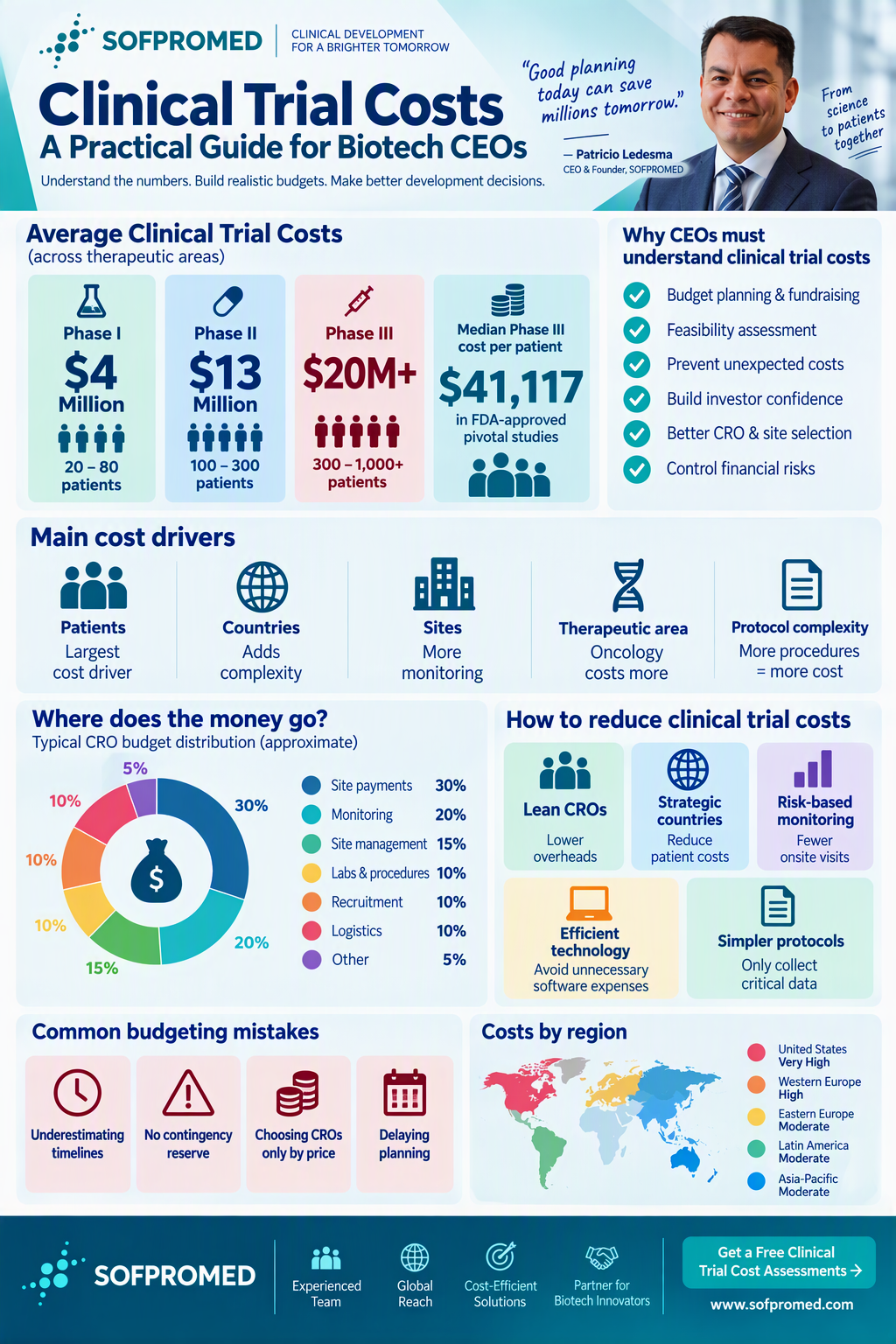
Typical Average Study Costs
| Study Phase | Approximate Average Cost |
| Phase I | $4 million |
| Phase II | $13 million |
| Phase III | $20 million+ |
Industry analyses have also shown that pivotal Phase III studies for regulatory approval can involve very significant per-patient costs, especially in complex therapeutic areas such as oncology.
The important thing to remember is that these are averages.
For example:
- A small Phase I study with 20 healthy volunteers may be relatively inexpensive.
- A rare disease trial requiring sophisticated imaging and laboratory analyses may be considerably more expensive.
- A multinational oncology study involving hundreds of patients can easily reach tens of millions of dollars.
The Main Factors That Drive Clinical Trial Costs
When biotech CEOs ask me for a budget estimate, I usually start with a series of questions.
The answers determine most of the final cost.
- Number of Patients
This is usually the biggest cost driver.
More patients mean:
- More site visits
- More laboratory tests
- More monitoring
- More data management
- More safety reporting
- More site payments
Increasing recruitment from 100 patients to 300 patients can completely change a budget.
- Number of Countries
A trial conducted in one country is generally much simpler than a trial conducted across five countries.
Additional countries require:
- More regulatory submissions
- More logistics
- More translations
- More oversight
- More local expertise
Every additional country introduces complexity.
- Number of Sites
There is a substantial difference between managing:
- 5 sites
- 25 sites
- 100 sites
Each site generates start-up activities, contracts, training requirements, monitoring visits, payments, and ongoing support.
- Therapeutic Area
Not all indications are equal.
Generally speaking:
| Therapeutic Area | Relative Cost Level |
| Dermatology | Lower |
| Medical Devices | Lower to Moderate |
| Infectious Diseases | Moderate |
| Neurology | High |
| Oncology | Very High |
| Rare Diseases | Very High |
More specialized assessments usually translate into higher costs.
- Protocol Complexity
A simple protocol is almost always less expensive.
A complex protocol might require:
- Multiple imaging procedures
- Frequent laboratory testing
- Central review committees
- Independent adjudication
- Biomarker analysis
- Complex statistical methodologies
A Typical CRO Budget Structure
One thing I like to explain to biotech executives is that clinical trials are not a single service.
They are many services combined together.
Most CRO proposals contain multiple operational sections.
Common Cost Categories
|
Budget Category |
Typical Purpose |
|
Regulatory Affairs |
Ethics and regulatory submissions |
|
Site Selection |
Identification of suitable hospitals |
|
Site Contracting |
Contract negotiation and execution |
|
Site Activation |
Site training and initiation |
|
Site Management |
Ongoing site support |
|
Monitoring |
Source data verification and oversight |
|
Safety Management |
Serious adverse event management |
|
Drug Logistics |
Investigational product distribution |
|
Data Management |
Database management and cleaning |
|
Biostatistics |
Statistical analyses |
|
Medical Writing |
Clinical study reports and submissions |
|
Project Management |
Overall trial coordination |
|
Quality Assurance |
Compliance reviews and audits |
Understanding these categories allows sponsors to compare quotations more intelligently.
Sometimes two CROs provide very different total prices simply because their assumptions are different.
Where Does Most of the Money Usually Go?
Many biotech CEOs are surprised when they see the detailed breakdown.
They often assume regulatory submissions are the most expensive component.
In reality, they are usually not.
The biggest expense categories are often:
- Site payments
- Monitoring
- Site management
- Patient recruitment
- Central laboratories
- Medical procedures
- Drug supply logistics
Monitoring alone can become one of the largest operational expenses because it continues throughout the study and requires frequent visits to each site.
Why Small Biotech Companies Often Struggle with Clinical Trial Costs
Large pharmaceutical companies have enormous budgets.
Most biotech startups don't.
This creates a significant challenge.
Many emerging biotech companies are trying to:
- Advance novel therapies
- Generate clinical proof of concept
- Preserve cash runway
- Reach value-inflection milestones
- Attract investors
At the same time.
This means they need clinical development strategies that are not only scientifically sound but also financially efficient.
In my experience, small biotech companies do not necessarily need a cheaper trial.
They need a smarter trial.
How to Reduce Clinical Trial Costs Without Sacrificing Quality
This is probably the section most biotech CEOs are interested in.
The good news is that there are legitimate ways to reduce costs while maintaining high-quality execution.
Let's discuss the most important ones.
- Work With Lean CROs
Large multinational CROs sometimes have significant overhead structures.
Naturally, these costs are reflected in sponsor budgets.
Smaller specialized CROs can often provide equivalent service quality while operating more efficiently.
A lean organizational structure can reduce costs substantially.
- Select Countries Strategically
Many sponsors immediately think about running studies in the United States.
Sometimes this makes sense.
Sometimes it doesn't.
Different countries can have dramatically different costs for:
- Hospital procedures
- Investigator fees
- Imaging studies
- Laboratory services
- Patient recruitment
Choosing the right countries can generate significant savings.
Strategic site selection is one of the most effective cost-reduction mechanisms available to sponsors.
Example
| Region | Relative Cost Level |
| United States | Very High |
| Western Europe | High |
| Eastern Europe | Moderate |
| Latin America | Moderate |
| Selected Asia-Pacific Countries | Moderate |
Of course, cost should never be the only criterion.
Regulatory strategy, recruitment capability, and data quality remain essential.
- Optimize Monitoring Strategies
Historically, clinical trials relied heavily on intensive onsite monitoring.
Today, risk-based monitoring approaches can significantly improve efficiency.
This may involve:
- Centralized monitoring
- Risk-based monitoring
- Remote review activities
- Targeted onsite visits
Well-designed monitoring plans can reduce costs without compromising compliance.
- Use Cost-Efficient Technology
Technology decisions can have a surprisingly large impact.
The selection of:
- Electronic Data Capture systems
- Trial Master File platforms
- Safety databases
- Project management software
can influence overall costs considerably.
Not every study requires the most expensive platform available.
Choosing technology that fits the study's requirements can deliver significant savings while maintaining quality standards.
- Avoid Overcomplicated Protocols
This may be the most overlooked opportunity.
Every additional assessment included in a protocol generates cost.
Before adding a procedure, sponsors should ask:
"Will this information materially impact decision-making?"
If the answer is no, eliminating that assessment may reduce burden for both patients and sites.
What I Tell Biotech CEOs Before They Start Budgeting
After years working with biotech startups, I repeatedly see the same budgeting mistakes.
Mistake #1: Underestimating Timelines
Longer timelines mean:
- More project management
- More monitoring
- More site support
- More vendor oversight
Time is expensive in clinical development.
Mistake #2: Ignoring Contingencies
Unexpected events happen regularly.
Examples include:
- Recruitment delays
- Protocol amendments
- Additional monitoring
- Regulatory questions
A contingency reserve is always recommended.
Mistake #3: Comparing CRO Quotes Only by Price
The cheapest proposal is not always the best proposal.
Sponsors should evaluate:
| Evaluation Criterion | Importance |
| Price | High |
| Team Experience | High |
| Therapeutic Expertise | High |
| Geographic Coverage | High |
| Quality Systems | Critical |
| Communication | Critical |
The best value is usually a balance between quality and cost.
My Personal Recommendation for Biotech Founders
If I could give only one piece of advice to biotech CEOs, it would be this:
Build your clinical budget before you actually need it.
Do not wait until investor meetings are scheduled.
Do not wait until the protocol is finalized.
Do not wait until your IND or CTA submission is approaching.
The earlier you understand your expected clinical expenses, the better your fundraising strategy will be.
At Sofpromed, one of the things I enjoy most is helping biotech executives build realistic development plans. Many founders are scientists, physicians, or entrepreneurs with excellent ideas but limited exposure to clinical operations budgeting.
A few conversations and a structured cost estimate can often save months of planning errors and potentially millions of dollars.
Final Thoughts
Clinical trials are expensive, but they do not have to be financially overwhelming.
The key is understanding what drives costs and making informed decisions from the beginning.
The number of patients, countries, sites, procedures, vendors, and operational requirements all contribute to the final budget. But with proper planning, strategic country selection, lean operational models, efficient technology, and experienced partners, sponsors can often achieve substantial savings.
As CEO of Sofpromed, my objective is simple: help biotech CEOs understand their clinical trial costs before they commit significant resources.
Good budgeting is not only about spending less money.
It is about spending the right money, in the right places, at the right time.
And in today's biotech environment, that can make the difference between a successful clinical development program and one that runs out of resources before reaching its milestones.
7 Key Questions and Answers About Clinical Trial Costs
- How much does a clinical trial usually cost?
There is no single answer because costs vary depending on the study design, therapeutic area, number of patients, countries involved, and protocol complexity. However, industry averages are approximately $4 million for Phase I, $13 million for Phase II, and $20 million or more for Phase III studies.
- What are the biggest factors that influence clinical trial costs?
The main cost drivers are:
- Number of patients
- Number of countries
- Number of sites
- Therapeutic area
- Protocol complexity
- Monitoring requirements
- Laboratory and imaging procedures
Generally, the larger and more complex the study, the higher the budget.
- Where does most of the clinical trial budget go?
The largest portions of a typical budget often go to:
- Site payments
- Site management
- Clinical monitoring
- Patient recruitment
- Medical procedures
- Central laboratories
- Drug logistics
Many biotech CEOs are surprised to learn that operational activities usually consume much more budget than regulatory submissions.
- Why do small biotech companies struggle with clinical trial budgets?
Most biotech startups operate with limited funding and must balance clinical development with fundraising, company growth, and investor expectations. As a result, they need not only affordable trials but also smarter and more efficient development strategies.
- How can biotech companies reduce clinical trial costs without reducing quality?
Several strategies can significantly reduce costs:
- Partnering with lean, specialized CROs
- Selecting cost-efficient countries and sites
- Using risk-based monitoring approaches
- Choosing appropriate technology platforms
- Avoiding unnecessary protocol procedures
When implemented correctly, these measures can improve efficiency while maintaining regulatory compliance and data quality.
- What budgeting mistakes do biotech CEOs commonly make?
The most common mistakes are:
- Underestimating study timelines
- Failing to include contingency reserves
- Selecting CROs based only on price
- Delaying budget planning until fundraising begins
These mistakes can lead to budget overruns, delays, and additional funding needs later in development.
- What is Patricio Ledesma's main message to biotech CEOs?
My main recommendation is simple:
Understand your clinical trial costs as early as possible.
The earlier a biotech company develops a realistic clinical budget, the easier it becomes to plan fundraising, manage investor expectations, select the right CRO partners, and avoid expensive surprises during execution.
Good budgeting is not about spending less money; it is about spending the right money in the right places to maximize the chances of clinical success.
Infographic for this article