

My name is Patricio Ledesma, and I serve as the Global Director of Clinical Operations at Sofpromed CRO, a company I founded in 2012.
Over the years, I have had the opportunity to work across a wide range of therapeutic areas and international markets, building a deep understanding of the financial side of clinical trials.
One of my core responsibilities is the preparation of clinical trial budgets (CRO quotations).
This is a critical task that requires translating complex protocols into detailed and realistic cost structures.
Through my work, I have gained extensive knowledge of the key cost drivers in clinical research, as well as how these vary significantly depending on the region.
Whether working in North America, Europe, or other global locations, I have developed a strong ability to evaluate site costs, regulatory requirements, patient recruitment challenges, and operational needs to create competitive financial proposals.
My experience has shown me that understanding clinical trial costs is essential for successful study planning.
Over time, I have refined a structured approach to building budgets that balances sponsor expectations with the realities of running studies on the ground.
I would like to share with you my experience on how clinical trial costs are calculated and provide a detailed example of a clinical trial budget (CRO quotation document), breaking down each component to give you a clear and practical understanding of the process.
Understanding the main sections of a clinical trial budget document
From my perspective as a CRO professional, a clinical trial budget document is much more than a simple financial estimate—it is a structured, detailed breakdown of all the activities required to successfully conduct a study.
This is the document we prepare to provide a transparent and comprehensive quotation to biotech and pharmaceutical clients, translating the clinical protocol into operational and financial terms.
When I build a budget, I follow a clear structure that reflects the lifecycle and timelines of the trial and the different functional areas involved.
Each section corresponds to a specific set of activities, resources, and expertise required to execute the study properly.
At a high level, a typical CRO budget is organized into the following main sections
- Ethics and Regulatory
This section covers all activities related to submissions to ethics committees and regulatory authorities. It includes preparation of submission packages, fees, and ongoing correspondence to ensure the study is compliant with local and international regulations.
- Site Contracting and Payments
Here, I include the negotiation and preparation of contracts with investigative sites, as well as the management of investigator payments throughout the study.
- Site Selection
This involves identifying and evaluating potential clinical sites. It includes feasibility assessments and any pre-selection visits needed to ensure sites are suitable for the study.
- Site Initiation and Activation
This section captures the activities required to prepare sites to begin the trial, including site initiation visits, training, and activation processes.
- Site Management
Once sites are active, they require ongoing support. This includes communication, issue resolution, and general coordination to ensure smooth trial conduct.
- Monitoring
Clinical monitoring is a major cost driver. It includes on-site and remote monitoring to ensure data quality, patient safety, and protocol compliance.
- Close-out
At the end of the study, sites must be properly closed. This section includes close-out visits and ensuring that all documentation is complete and compliant.
- Drug Safety
This area covers the management of adverse events, safety reporting, and compliance with pharmacovigilance requirements.
- Drug Logistics
This includes the shipment, storage, and handling of investigational medicinal products across all participating sites.
- Clinical Supplies Management
Beyond drug logistics, this section ensures that all study materials (kits, lab supplies, etc.) are properly managed and distributed.
- Medical Writing
Medical writing includes the preparation of clinical documents such as protocols, study reports, and regulatory documents.
- Project Management
Project management ensures overall coordination of the trial, including timelines, budgets, communication, and risk management.
- Quality Control
This section ensures that all processes meet quality standards, including audits, SOP compliance, and internal reviews.
- Administration
Administrative costs cover essential support functions that enable the trial to run efficiently, including finance, HR, and operational support.
- Data Management
Data management involves database design, data entry, cleaning, and validation to ensure high-quality datasets.
- Statistical Programming
Statistical programming includes data analysis, generation of tables/listings/figures, and support for study reporting.
- Pass-Through Costs
Finally, the pass-through costs section includes all those products and services that are not directly provided by the CRO, but by third parties.
By structuring the budget in this way, I ensure that every aspect of the clinical trial is accounted for, both operationally and financially.
This level of detail is essential not only for transparency with clients, but also to guarantee that the study can be executed efficiently without unexpected costs or delays.
Hourly rates for CRO services
From my experience, the fundamental building block for calculating CRO service costs in a clinical trial is the hourly rate assigned to each role involved in the project.
Every activity in a trial—whether operational, regulatory, or scientific—is ultimately performed by specialized professionals, and the total budget is derived by estimating the number of hours each role will dedicate and applying their corresponding rate.
While these rates can vary depending on geography, expertise, and complexity, I typically work with industry-average benchmarks such as (all prices shown in US dollars):
- Clinical Project Manager: $110–160/hour
- Clinical Research Associate (CRA): $80–140/hour
- Regulatory Specialist: $90–150/hour
- Site Contract Specialist: $80–120/hour
- Clinical Trial Assistant (CTA): $40–70/hour
- Medical Writer: $90–140/hour
- Quality Manager: $100–140/hour
- Clinical Data Manager: $80–120/hour
- Statistical Programmer: $90–130/hour
- Pharmacovigilance Specialist: $100–140/hour
- Medical Monitor: $250–350/hour
Please note that the prices in the higher end correspond to hourly rates for personnel located in North America (United States and Canada).
CRO staff hourly rates in Europe and other regions (not located in North America) are typically lower.
By combining these hourly rates with a detailed estimation of effort per task, I am able to construct a precise and realistic budget that reflects both the operational workload and the expertise required to successfully deliver the clinical trial.
Calculating a specific study budget: Phase 1 trial in oncology
In this example, I am working on a Phase 1 oncology clinical trial conducted in the United States, with the following key characteristics:
- Number of sites: 3
- Number of subjects: 15
- Study duration: 32 months total
- Start-up: 4 months
- Recruitment: 12 months
- Treatment: 6 months
- Follow-up: 6 months
- Close-out: 4 months
These parameters are critical because they directly drive effort, workload, and therefore cost.
Overall Budget Summary
I divide the budget into two main components:
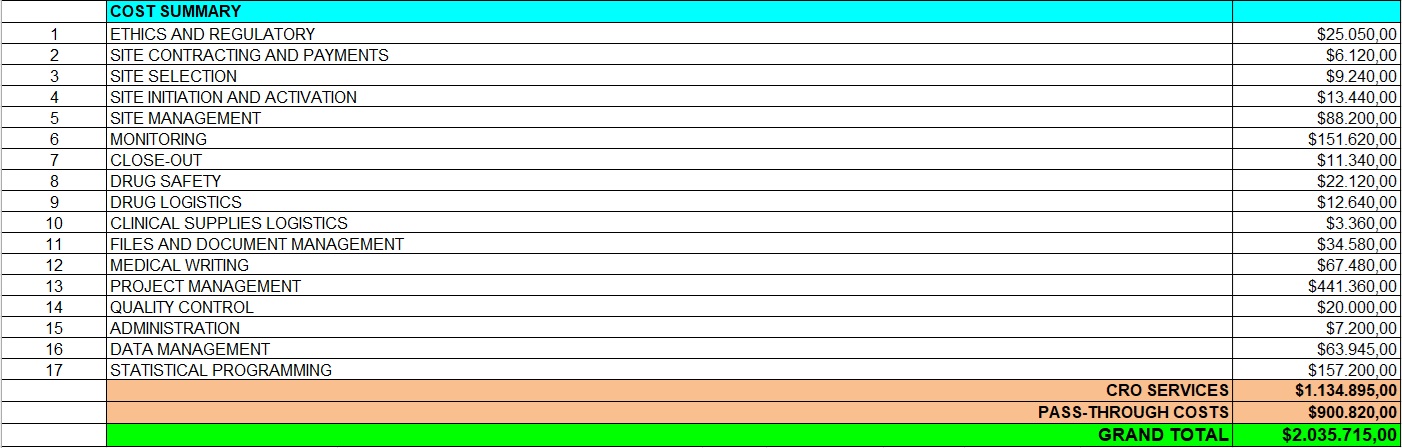
- CRO Service Costs - Total: $1,134,895
This reflects all operational work performed by the CRO, fully calculated using hourly rates and effort estimates.
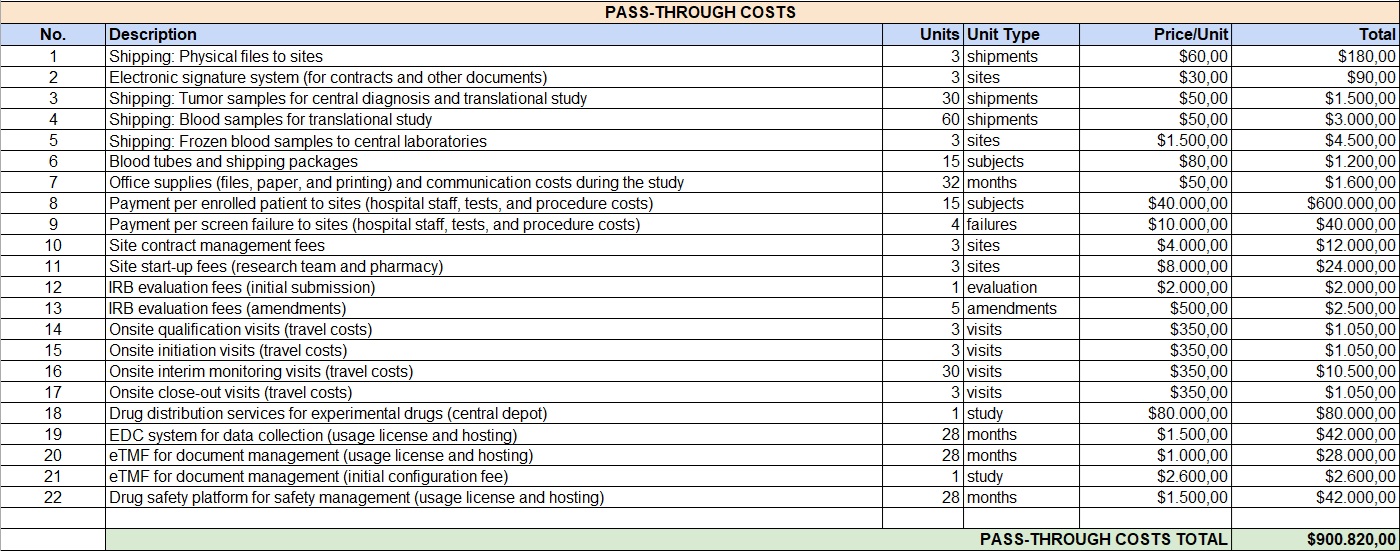
- Pass-Through Costs - Total: $900,820
These are third-party or direct costs (sites, vendors, platforms, logistics).
Grand Total = $2,035,715
How I Calculate Each Section (Hourly Rate-Based Approach)
The entire CRO services budget is built from a simple principle: Hours per task × hourly rate per role.
Below is how I apply that logic across sections.
Please note that I only mention the total amount of money for each section, and then some explanations regarding how some sub-items (not all them) are calculated.
If you wish to get the full Excel file I used for this budget example, including the description of every single line item, send me an email to: pledesma@sofpromed.com
Ethics and Regulatory – $25,050
I estimate hours for submissions, amendments, and reporting:
- Example: IRB submission = 32 hours × $150/hour
- Amendments = 16 hours each × 5 expected amendments
Site Contracting and Payments – $6,120
- Contracts: 12 hours per site × $120/hour
- Payments management handled by administrative roles at lower rates
Site Selection – $9,240
Driven by feasibility and qualification visits:
- On-site SQV: 15 hours per visit × $140/hour
- Remote SQV: fewer hours, lower cost
Site Initiation and Activation – $13,440
- On-site SIV: 20 hours per visit
- Remote SIV: 10 hours per visit
Site Management – $88,200
This is time-driven over months:
- Recruitment & treatment: 10 hours per site/month
- Follow-up: 5 hour per site/month
Monitoring – $151,620
One of the main cost drivers:
- On-site IMVs: 25 hours per visit
- Remote IMVs: 11 hours per visit
- Data reviews: 8 hours per subject
Close-out – $11,340
- Close-out visits (on-site)
- Up to 27 hours per visit onsite
Drug Safety – $22,120
- SAE management: 4 hours per SAE
- SUSARs: 8 hours each
- DSUR writing: 24 hours per report
Drug Logistics – $12,640
- Monthly coordination effort
- Shipment tracking and depot management
Clinical Supplies Logistics – $3,360
- Kit preparation: 1 hour per kit
- Tracking: 0.5 hours per site/month
Files and Document Management – $34,580
- TMF setup: 40 hours
- TMF maintenance: 3 hours per site per month
Medical Writing – $67,480
- Protocol: 200 hours
- CSR: 150 hours
- Manuscript: 100 hours
Project Management – $441,360 (largest driver)
- Study management:
- 80 hours/month (active phases)
- 40 hours/month (follow-up/close-out)
- Continuous meetings, oversight, reporting
Quality Control – $20,000
- Audits: 80 hours each
- Protocol deviations: 2 hours per deviation
Administration – $7,200
- Monthly administrative support
- ~5 hours/month
Data Management – $63,945
- EDC build: 7 hours per form
- Data cleaning: 8 hours per subject
- Coding and reconciliation tasks
Statistical Programming – $157,200
- SAP: 80 hours
- TFL programming: 4 hours per table, figure, listing
- SDTM/ADaM datasets and validation
Hourly Rates Used
The entire model is based on defined hourly rates:
- Clinical Project Manager: $160/hour
- Senior CRA: $140/hour
- Regulatory Specialist: $150/hour
- Site Contract Specialist: $120/hour
- CTA: $70/hour
- Medical Writer: $140/hour
- Quality Manager: $100/hour
- Clinical Data Manager: $90/hour
- Statistical Programmer: $100/hour
- Administrative Assistant: $60/hour
Pass-Through Costs Breakdown ($900,820)
These are not effort-based—they are costs paid to third parties.
Key components:
Site Costs (Largest driver):
- Patient cost: $40,000 per subject → $600,000
- Screen failures: $40,000
- Site start-up fees: $24,000
Technology Platforms:
- EDC system: $42,000
- eTMF: $28,000 + $2,600 setup
- Safety platform system: $42,000
Below is the summary of all the pass-through and global costs for this study:
My Key Takeaways
When I build a budget like this, I ensure:
- Every cost is traceable to effort or unit assumptions
- All hours are justified per activity
- Major drivers (monitoring, PM, site costs) are clearly visible
- Clients understand exactly where their investment goes
This is what allows me to produce realistic, transparent, and defensible clinical trial budgets that align operational reality with financial planning.
If you wish to receive via email the actual full Excel file for the budget discussed in this post, including all the line items in detail, please contact me at: pledesma@sofpromed.com