By Patricio Ledesma
Table of Contents
Clinical trials generate enormous amounts of data.
Every patient visit generates information.
Every laboratory test produces datasets.
Every efficacy endpoint and safety assessment must be analyzed accurately.
Behind every successful clinical trial is a strong statistical programming team.
These professionals transform raw clinical data into meaningful information that can support regulatory submissions, scientific publications, and business decisions.
Throughout my career in clinical research, I have worked with many biotechnology companies, academic institutions, and research organizations that faced a common challenge.
They needed experienced SAS programmers.
They needed support quickly.
They needed flexibility.
Most importantly, they needed a cost-effective solution.
Building a large internal statistical programming department is not realistic for many organizations.
This is especially true for emerging biotech companies and academic research groups that must manage limited budgets carefully.
For these organizations, the Functional Service Provider (FSP) model can be an excellent solution.
At Sofpromed, we provide FSP Statistical Programming Services that allow sponsors to obtain experienced programming resources rapidly, efficiently, and at competitive rates.
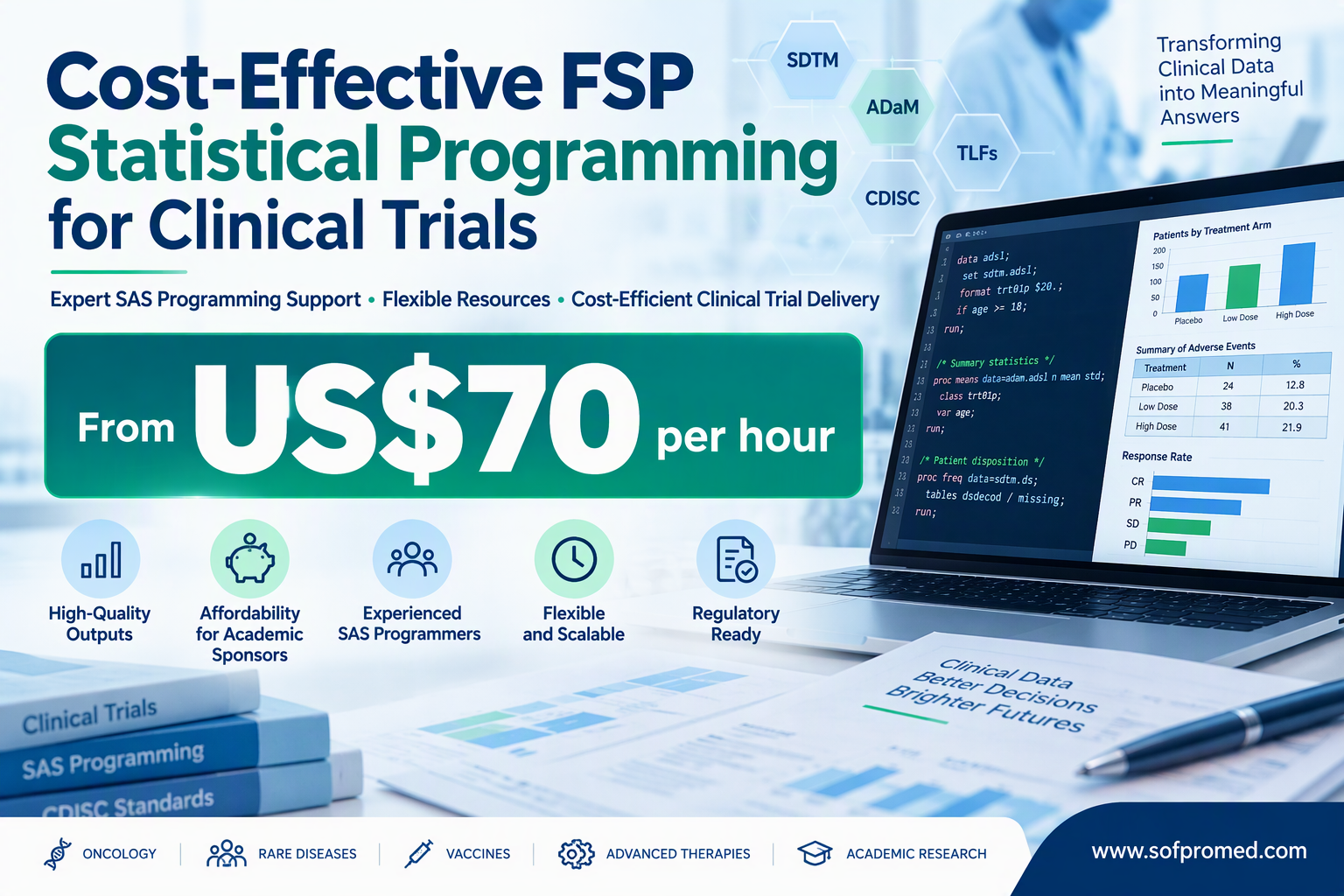
For academic sponsors, our statistical programming services start at US$70 per hour, providing an affordable way to access experienced SAS programming expertise without the overhead associated with traditional outsourcing models.
In this article, I will explain why the FSP model is becoming increasingly popular, how it helps sponsors reduce costs, and why it can be one of the fastest ways to obtain SAS programming expertise for clinical trials.
What Is an FSP Statistical Programming Model?
FSP stands for Functional Service Provider.
In this model, sponsors obtain specialized resources dedicated to a specific function.
Instead of outsourcing an entire clinical trial, the sponsor gains access to experienced professionals who support a particular operational area.
In this case, statistical programming.
The sponsor maintains oversight and control.
The programming team functions as an extension of the sponsor's internal organization.
This approach combines flexibility, quality, and cost efficiency.
FSP statistical programmers may support:
- SDTM programming
- ADaM programming
- CDISC implementation
- TLF generation
- Define.xml production
- Validation programming
- Regulatory submissions
- Interim analyses
- Database lock activities
- Patient profiles
- Integrated summaries
- ISS and ISE creation
- Clinical study reports
The sponsor receives expert programming support without needing to hire permanent employees.
Why Is Statistical Programming So Important?
Statistical programming is one of the most critical activities in clinical development.
Data alone has little value until it can be transformed into meaningful information.
Regulators do not review raw databases.
They review carefully structured datasets, tables, listings, figures, and statistical outputs.
Statistical programmers help create:
- SDTM datasets
- ADaM datasets
- Tables
- Listings
- Figures
- Regulatory submission packages
Without experienced programmers, sponsors may encounter:
- Delayed timelines
- Validation issues
- Dataset inconsistencies
- Analysis errors
- Submission delays
- Increased regulatory questions
Many costly problems can be prevented through high-quality programming support.
This is why the selection of an experienced programming partner is so important.
Challenges Faced by Small Biotechnology Companies
Small biotechnology companies often operate with limited resources.
Many organizations have:
- Fewer than 20 employees
- Limited investor funding
- One or two clinical programs
- Aggressive development timelines
These sponsors typically need expert programming support.
However, they often do not have enough work to justify maintaining a permanent programming department.
For example, a startup may require:
- SDTM support for six months
- ADaM programming for four months
- Submission support near study completion
Hiring full-time employees for these temporary needs may not be financially sensible.
An FSP model solves this problem.
Sponsors can access expertise exactly when needed.
Resources can scale up or down depending on project requirements.
The result is greater efficiency and lower cost.
Why Academic Sponsors Benefit from FSP Models
Academic clinical trials face unique challenges.
Research grants must be managed carefully.
Funding is often limited.
Every expenditure must be justified.
Many universities and hospitals conduct high-quality research but lack dedicated SAS programming departments.
As studies become more complex, the need for professional statistical programming increases.
Academic sponsors often require support for:
- Investigator-initiated studies
- Oncology research
- Rare disease trials
- Registry analyses
- Observational studies
- Grant-funded clinical trials
Unfortunately, traditional CRO pricing can consume a significant portion of available funding.
This is where FSP programming can create substantial value.
By accessing experienced programmers only when required, academic institutions can allocate more resources toward:
- Patient recruitment
- Laboratory assessments
- Biomarker studies
- Site management
- Follow-up activities
This allows researchers to maximize the scientific impact of their budgets.
The Cost Problem with Traditional Outsourcing
Many large CROs maintain complex organizational structures.
These include:
- Multiple management layers
- Administrative departments
- Corporate overhead
- Global infrastructure
These costs are frequently reflected in hourly programming rates.
Typical industry rates may include:
Table 1: Typical statistical programming hourly rates in commercial clinical research
|
Resource Type |
Typical Hourly Rate |
|
Junior Programmer |
US$90-150 |
|
Intermediate Programmer |
US$120-180 |
|
Senior Programmer |
US$160-250 |
|
Principal Programmer |
US$200-350+ |
For a clinical trial requiring several hundred programming hours, costs can increase rapidly.
A project requiring 800 hours of programming could cost:
Table 2: Estimated statistical programming cost for a clinical study
|
Rate |
Total Cost |
|
US$150/hour |
US$120,000 |
|
US$200/hour |
US$160,000 |
|
US$250/hour |
US$200,000 |
For early-stage biotechnology companies and academic sponsors, these expenditures can be significant.
Why Is the FSP Model More Cost Effective?
Several factors contribute to the efficiency of the FSP model.
- Sponsors Pay for Expertise
Sponsors obtain direct access to programmers.
They are not paying for unnecessary organizational overhead.
- Flexible Utilization
Resources are allocated according to actual project needs.
There is no need to maintain idle staff during periods of lower activity.
- Scalability
Programming teams can expand during intensive periods and contract after major milestones.
- Faster Startup
Experienced programmers can begin work rapidly.
Sponsors avoid lengthy recruitment processes.
- Better Budget Control
Work can be planned according to available funding and study priorities.
This flexibility makes the FSP model particularly attractive for lean organizations.
Sofpromed's Approach to FSP Statistical Programming
At Sofpromed, our objective is straightforward.
We provide high-quality statistical programming support at competitive rates.
Our programming teams have experience supporting:
- Phase I studies
- First-in-human trials
- Phase II programs
- Phase III studies
- Oncology trials
- Rare disease research
- Medical device investigations
- Cell therapy programs
- Gene therapy studies
- Academic clinical research
Our services include:
- SDTM development
- ADaM development
- TLF production
- Define.xml creation
- Validation programming
- Submission support
- CSR outputs
- ISS and ISE programming
Because statistical programming is one of our core service areas, we can provide resources quickly and efficiently.
The goal is always the same.
Deliver high-quality outputs while controlling costs.
Statistical Programming Rates Starting at US$70 Per Hour for Academic Sponsors
One of the most important advantages we offer to academic institutions is affordability.
Many academic studies operate under strict grant restrictions.
Investigators need access to expertise without consuming large portions of their available funding.
For qualifying academic sponsors, Sofpromed offers statistical programming rates starting at US$70 per hour.
This pricing can produce meaningful savings compared with traditional outsourcing alternatives.
Consider the following example.
Table 3: Cost Saving for Different Hourly Rates
|
Programming Hours |
At US$70/hour |
At US$150/hour |
|
200 Hours |
US$14,000 |
US$30,000 |
|
500 Hours |
US$35,000 |
US$75,000 |
|
1,000 Hours |
US$70,000 |
US$150,000 |
Potential savings remain substantial.
These funds could be redirected toward:
- Additional patients
- Additional study sites
- Biomarker analyses
- Statistical analyses
- Scientific publications
- Extended follow-up
The result is more science for the same budget.
Rapid Access to SAS Programming Know-How
Finding experienced SAS programmers is not always easy.
The hiring process can take several months.
Sponsors may need to:
- Advertise positions
- Screen candidates
- Conduct interviews
- Negotiate salaries
- Complete onboarding
This consumes valuable time.
Clinical trials rarely have the luxury of waiting several months for specialized expertise.
The FSP model eliminates much of this delay.
Sponsors gain rapid access to experienced programmers who already understand:
- SAS programming
- CDISC standards
- Clinical trial workflows
- FDA expectations
- EMA requirements
- Submission processes
This creates a smooth pathway to obtaining programming expertise without lengthy recruitment cycles.
A Seamless Extension of Your Clinical Team
One of the greatest strengths of the FSP model is its simplicity.
The programming team operates as an extension of the sponsor's organization.
Communication remains direct.
Decision-making remains efficient.
Study priorities remain under sponsor control.
Sponsors enjoy many benefits typically associated with internal teams while avoiding:
- Recruitment costs
- Employment liabilities
- Training expenses
- Staff turnover risks
- Long-term employment commitments
This combination of flexibility and expertise makes the model highly attractive.
Support During Database Lock
Database lock is often one of the most intense periods in a clinical trial.
Programming workloads increase dramatically.
Teams may need to deliver:
- Final SDTM datasets
- Final ADaM datasets
- Tables
- Listings
- Figures
- Validation packages
- Submission outputs
Many sponsors do not require large programming groups throughout the study.
However, they often need additional support during database lock.
An FSP model makes rapid scaling possible.
Additional programmers can be deployed quickly to meet critical deadlines.
This helps reduce risk and maintain timelines.
Why Oncology Sponsors Frequently Choose FSP Support
Oncology studies often require sophisticated statistical programming.
Many cancer trials include:
- Time-to-event endpoints
- Progression-free survival analyses
- Overall survival analyses
- Tumor response assessments
- Biomarker evaluations
- Complex stratification methods
These analyses require specialized knowledge and significant programming effort.
Emerging oncology companies frequently prefer the FSP model because they gain access to expertise without committing to a large permanent programming organization.
This allows valuable capital to remain focused on drug development activities.
Example of Potential Cost Savings
Consider a hypothetical Phase II oncology study requiring 800 hours of programming effort.
Table 4: Statistical programming hours required in Phase II oncology study
|
Programming Activity |
Hours |
|
SDTM Programming |
250 |
|
ADaM Programming |
180 |
|
TLF Generation |
220 |
|
Validation |
100 |
|
Submission Support |
50 |
|
Total |
800 |
Now compare costs.
Table 5: Statistical programming cost for different hourly rates
|
Hourly Rate |
Total Cost |
|
US$200/hour |
US$160,000 |
|
US$150/hour |
US$120,000 |
|
US$70/hour |
US$56,000 |
Compared with a US$200/hour model, the potential savings could reach:
US$104,000
That budget could potentially support:
- Additional clinical sites
- Additional patients
- Biomarker testing
- Central laboratory activities
- Data management resources
The financial impact can be significant.
Quality Must Always Come First
Reducing costs should never mean sacrificing quality.
An effective programming partner should offer:
- Strong SAS expertise
- CDISC knowledge
- Regulatory experience
- Validation capabilities
- Therapeutic expertise
- Excellent communication
Quality programming helps sponsors avoid expensive rework later.
The objective should always be to combine affordability with expertise.
When this balance is achieved, sponsors can improve both efficiency and study quality.
The Growing Future of FSP Statistical Programming
The clinical research industry continues moving toward flexible staffing models.
Sponsors increasingly demand:
- Agility
- Scalability
- Cost control
- Fast access to expertise
- Operational efficiency
The FSP model addresses each of these needs.
This trend is especially visible among:
- Venture-backed biotech companies
- Emerging pharmaceutical companies
- Academic medical centers
- Universities
- Non-profit research organizations
As clinical development becomes more specialized, demand for flexible expert resources is likely to continue growing.
Final Thoughts
Throughout my career, I have seen many sponsors struggle to balance quality, speed, and cost.
Small biotechnology companies need experienced programming support but often cannot justify building a large internal department.
Academic sponsors need expert SAS programming while working within limited grant budgets.
The Functional Service Provider model offers an effective solution.
It provides flexibility.
It offers scalability.
It improves budget efficiency.
It delivers rapid access to SAS programming expertise.
At Sofpromed, we have built our FSP statistical programming services around these principles.
For qualifying academic sponsors, our rates start at US$70 per hour, allowing research organizations to access experienced statistical programmers at highly competitive pricing.
In my opinion, this is one of the most practical approaches available today for sponsors seeking reliable, high-quality, and affordable statistical programming support.
The goal is simple.
Generate accurate datasets.
Create reliable analyses.
Maintain regulatory compliance.
Control costs.
And ultimately help bring innovative therapies to patients faster.
That is the value of a well-executed FSP Statistical Programming model.