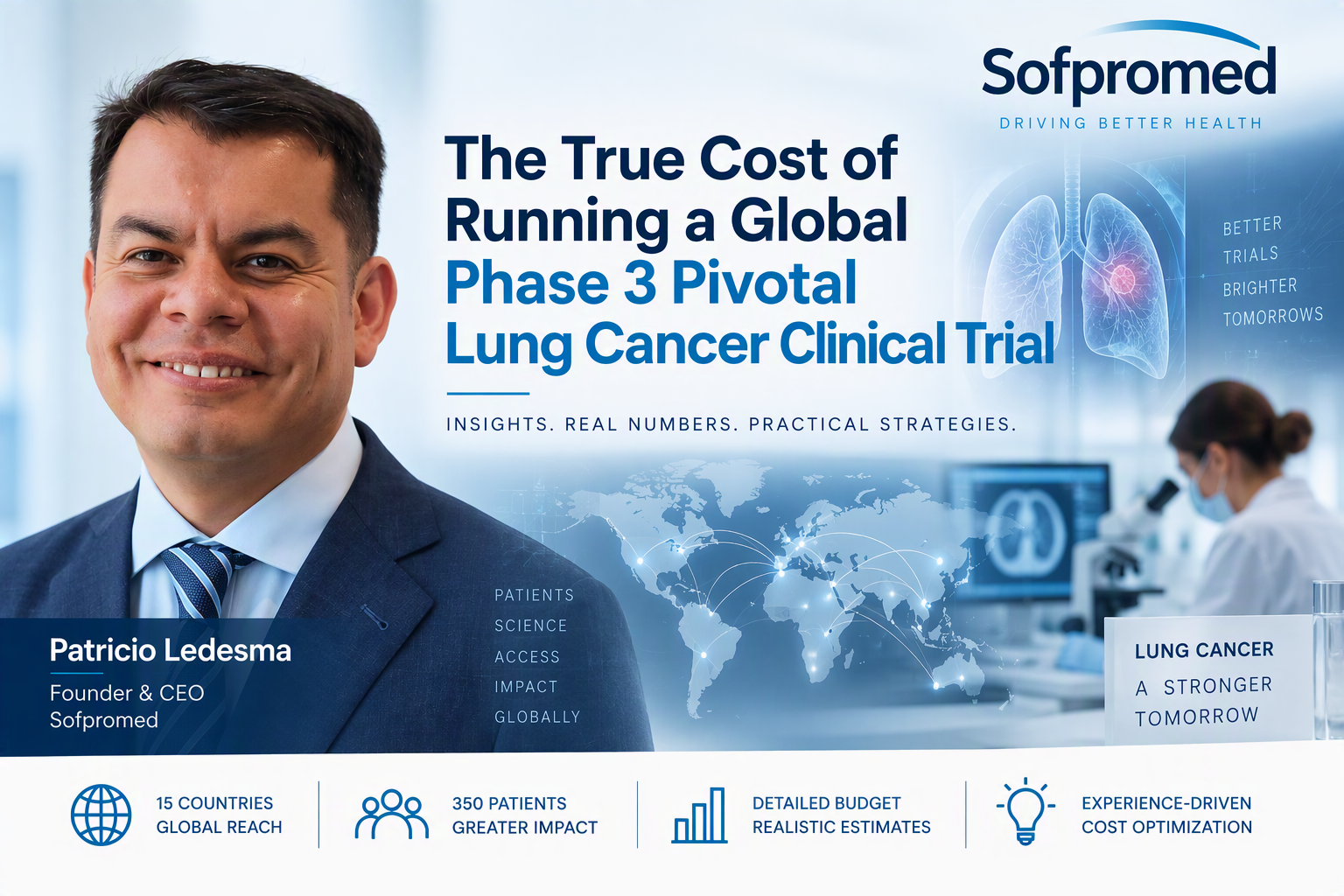
By Patricio Ledesma, Founder & CEO, Sofpromed
Table of Contents
One of the most important budgeting exercises for any oncology biotech company is estimating the cost of a global Phase 3 pivotal clinical trial.
Having supported sponsors in international oncology programs, I have found that many teams underestimate both the operational complexity and the financial investment required, particularly when overall survival endpoints are involved.
In this article, I will provide a realistic budget model for a Phase 3 pivotal lung cancer study enrolling 350 patients across 15 countries, including:
- United States
- Canada
- Australia
- Taiwan
- Singapore
- Japan
- South Korea
- United Kingdom
- Spain
- France
- Italy
- Germany
- Slovakia
- Greece
- Poland
For this example, I assume:
|
Parameter |
Assumption |
|
Indication |
Lung Cancer |
|
Phase |
Phase III Pivotal |
|
Patients |
350 |
|
Countries |
15 |
|
Sites |
85 |
|
Average Patients per Site |
4.1 |
|
Start-Up |
8 Months |
|
Recruitment |
36 Months |
|
Survival Follow-Up |
24 Months |
|
Close-Out |
6 Months |
|
Total Project Duration |
74 Months |
Because this study includes a lengthy survival follow-up period and multiple regions across North America, Europe, and Asia-Pacific, the overall budget is substantial.
Executive Budget Summary
Table 1. Overall Trial Budget
|
Category |
Cost (USD) |
|
CRO Full Services |
$32,800,000 |
|
Pass-Through Costs |
$83,500,000 |
|
Contingency Reserve (10%) |
$11,600,000 |
|
Total Estimated Budget |
$127,900,000 |
For a registration-enabling global lung cancer trial, I would generally advise sponsors to budget between $115 million and $140 million.
Budget Allocation: CRO vs Pass-Through Costs
A common misconception is that CRO costs represent most of the trial budget.
In reality, site grants, imaging, central laboratories, biomarker analyses, and drug logistics usually account for the majority of spending.
Table 2. Budget Split
|
Category |
Cost |
Percentage |
|
CRO Services |
$32.8 M |
26% |
|
Pass-Through Costs |
$83.5 M |
65% |
|
Contingency |
$11.6 M |
9% |
|
Total |
$127.9 M |
100% |
Typical Distribution
From my experience, pivotal oncology studies often fall within these ranges:
|
Component |
Typical % |
|
CRO Services |
20-30% |
|
Pass Through |
60-70% |
|
Contingency |
5-10% |
Detailed CRO Full-Service Budget
The following table assumes a full-service outsourcing model.
Table 3. CRO Services Budget
|
Service |
Cost (USD) |
|
Global Project Management |
$3,800,000 |
|
Clinical Operations Management |
$2,400,000 |
|
Clinical Monitoring |
$8,700,000 |
|
Data Management |
$2,400,000 |
|
Database Build & Validation |
$900,000 |
|
Biostatistics |
$1,900,000 |
|
Statistical Programming |
$1,500,000 |
|
Medical Writing |
$950,000 |
|
Pharmacovigilance |
$2,800,000 |
|
Medical Monitoring |
$2,300,000 |
|
Regulatory Affairs |
$1,300,000 |
|
Vendor Management |
$1,000,000 |
|
TMF Management |
$900,000 |
|
Quality Assurance |
$900,000 |
|
GCP Audits |
$800,000 |
|
Site Activation Management |
$850,000 |
|
Clinical Supply Coordination |
$700,000 |
|
Study Close-Out and Archiving |
$700,000 |
|
Total |
$32,800,000 |
Detailed Pass-Through Costs
Table 4. Investigator Sites and Patient Costs
|
Item |
Cost (USD) |
|
Site Start-Up Fees |
$3,200,000 |
|
Ethics and Local Site Fees |
$900,000 |
|
Investigator Payments |
$25,000,000 |
|
Clinical Procedure Reimbursement |
$11,200,000 |
|
Pharmacy Fees |
$1,800,000 |
|
Study Coordinators |
$5,500,000 |
|
Patient Travel Reimbursement |
$1,400,000 |
|
Retention Programs |
$800,000 |
|
Site Archiving |
$300,000 |
|
Subtotal |
$50,100,000 |
Table 5. Central Laboratory and Biomarker Costs
Lung cancer trials frequently incorporate biomarker-driven enrollment and translational medicine analyses.
|
Item |
Cost (USD) |
|
Central Laboratory Services |
$5,000,000 |
|
Specimen Logistics |
$1,400,000 |
|
EGFR Testing |
$1,000,000 |
|
ALK Testing |
$800,000 |
|
ROS1 Testing |
$500,000 |
|
PD-L1 Testing |
$2,000,000 |
|
Next Generation Sequencing (NGS) |
$4,500,000 |
|
Histopathology Review |
$1,500,000 |
|
Biorepository Storage |
$600,000 |
|
Biomarker Data Integration |
$700,000 |
|
Subtotal |
$18,000,000 |
Table 6. Imaging Costs
Imaging is often one of the most underestimated oncology expenses.
Site Imaging Procedures
|
Item |
Cost (USD) |
|
CT Scans |
$4,200,000 |
|
PET-CT Scans |
$3,800,000 |
|
MRI Procedures |
$1,500,000 |
|
Imaging Upload Activities |
$500,000 |
|
Subtotal |
$10,000,000 |
Central Imaging Review
|
Item |
Cost (USD) |
|
Independent Radiology Review Committee |
$1,800,000 |
|
RECIST Review |
$1,200,000 |
|
Imaging Platform |
$700,000 |
|
Adjudications |
$500,000 |
|
Subtotal |
$4,200,000 |
Total Imaging Cost
|
Category |
Amount |
|
Site Imaging |
$10,000,000 |
|
Central Review |
$4,200,000 |
|
Total |
$14,200,000 |
Table 7. Regulatory and Insurance Costs
|
Item |
Cost (USD) |
|
Regulatory Authority Fees |
$850,000 |
|
Ethics Committee Fees |
$600,000 |
|
Country Submissions |
$900,000 |
|
Clinical Trial Insurance |
$1,000,000 |
|
Legal Documentation |
$450,000 |
|
Subtotal |
$3,800,000 |
Table 8. Clinical Technology Platforms
|
Item |
Cost (USD) |
|
EDC System |
$1,000,000 |
|
RTSM/IWRS |
$900,000 |
|
ePRO/eCOA |
$1,200,000 |
|
Safety Database |
$500,000 |
|
CTMS |
$450,000 |
|
Data Warehouse |
$650,000 |
|
System Integrations |
$700,000 |
|
Subtotal |
$5,400,000 |
Table 9. Drug Supply Chain and Logistics
|
Item |
Cost (USD) |
|
Packaging |
$1,200,000 |
|
Labeling |
$800,000 |
|
Regional Depots |
$2,000,000 |
|
Cold Chain Logistics |
$4,000,000 |
|
Import and Export Activities |
$1,500,000 |
|
Drug Accountability |
$500,000 |
|
Drug Destruction |
$200,000 |
|
Subtotal |
$10,200,000 |
Cost by Country
Table 10. Country Allocation
|
Country |
Patients |
Estimated Cost (USD) |
|
United States |
70 |
$33.0 M |
|
Canada |
20 |
$6.0 M |
|
Australia |
20 |
$5.5 M |
|
Taiwan |
15 |
$3.8 M |
|
Singapore |
10 |
$3.5 M |
|
Japan |
35 |
$12.0 M |
|
South Korea |
25 |
$7.0 M |
|
United Kingdom |
25 |
$7.5 M |
|
Spain |
30 |
$6.5 M |
|
France |
25 |
$7.2 M |
|
Italy |
20 |
$5.5 M |
|
Germany |
25 |
$8.5 M |
|
Slovakia |
10 |
$2.0 M |
|
Greece |
10 |
$2.1 M |
|
Poland |
10 |
$2.3 M |
|
Total |
350 |
$112.4 M |
Major Cost Drivers in Lung Cancer Studies
In my experience, the largest budget drivers are:
- Overall Survival Follow-Up
- 24 months of survival monitoring significantly extends staffing costs.
- Central Imaging Review
- RECIST-based endpoint adjudication can cost millions in global studies.
- Biomarker Strategy
- PD-L1, EGFR, ALK, ROS1, KRAS and NGS testing substantially increase costs.
- Japan and United States Participation
- Critical for future regulatory strategy, but among the most expensive regions.
- Monitoring Burden
- Multiregional trials with 85 sites require extensive monitoring resources.
My Top Cost-Minimization Strategies
Over the years, I have seen certain strategies consistently reduce oncology development costs while maintaining quality.
- Select Fewer High-Recruiting Sites
An oncology site enrolling 15 patients is dramatically more efficient than three sites enrolling five patients each.
The savings include:
- Site start-up
- Contracts
- Regulatory maintenance
- Monitoring
- TMF management
Potential savings can exceed $3 million to $5 million.
- Prioritize Strong Recruiting Countries
Countries that frequently provide excellent lung cancer enrollment performance include:
- Spain
- Poland
- Greece
- South Korea
- Italy
High-performing countries reduce timeline risk and lower overall study cost.
- Perform Centralized Biomarker Testing
Consolidating testing through a small number of specialized laboratories reduces variability and often lowers total expenditures.
- Use Risk-Based Monitoring
Applying ICH E6(R3) risk-based monitoring approaches can reduce monitoring costs by 15% to 25% without compromising quality.
- Avoid Protocol Amendments
The most expensive mistake in a pivotal oncology study is often a protocol amendment.
For a trial of this size, a major amendment can easily cost:
$1 million to $5 million
through:
- site retraining
- new submissions
- revised contracts
- database updates
- delayed recruitment
- Forecast Recruitment Monthly
I strongly recommend implementing recruitment forecasting beginning with the first enrolled patient.
Early intervention is far cheaper than launching late-stage rescue initiatives.
- Use an Experienced Oncology CRO
Sponsors sometimes select a CRO based exclusively on price.
In my experience, oncology expertise is often far more valuable than the lowest proposal. An experienced team can prevent operational issues that ultimately cost far more than the initial savings.
How Sofpromed Supports Global Oncology Programs
At Sofpromed, we support biotechnology and pharmaceutical companies conducting multinational oncology trials through:
- Global project management
- Clinical operations
- Monitoring
- Medical monitoring
- Pharmacovigilance
- Regulatory affairs
- Data management
- Statistical programming
- Biostatistics
- Medical writing
- Vendor management
- Quality assurance
Our objective is always to improve study execution, increase recruitment efficiency, maintain high-quality data, and reduce unnecessary operational costs.
Final Summary
For a 350-patient Phase 3 pivotal lung cancer trial conducted across 15 countries over approximately 74 months, sponsors should realistically budget approximately $120 million to $130 million USD.
The biggest opportunities for cost control are not found in negotiating small line-item discounts.
In my experience, the greatest savings come from selecting the right countries, minimizing protocol amendments, concentrating enrollment among high-performing sites, leveraging centralized biomarker testing, and partnering with experienced oncology development teams that understand the complexities of global registration-enabling studies.