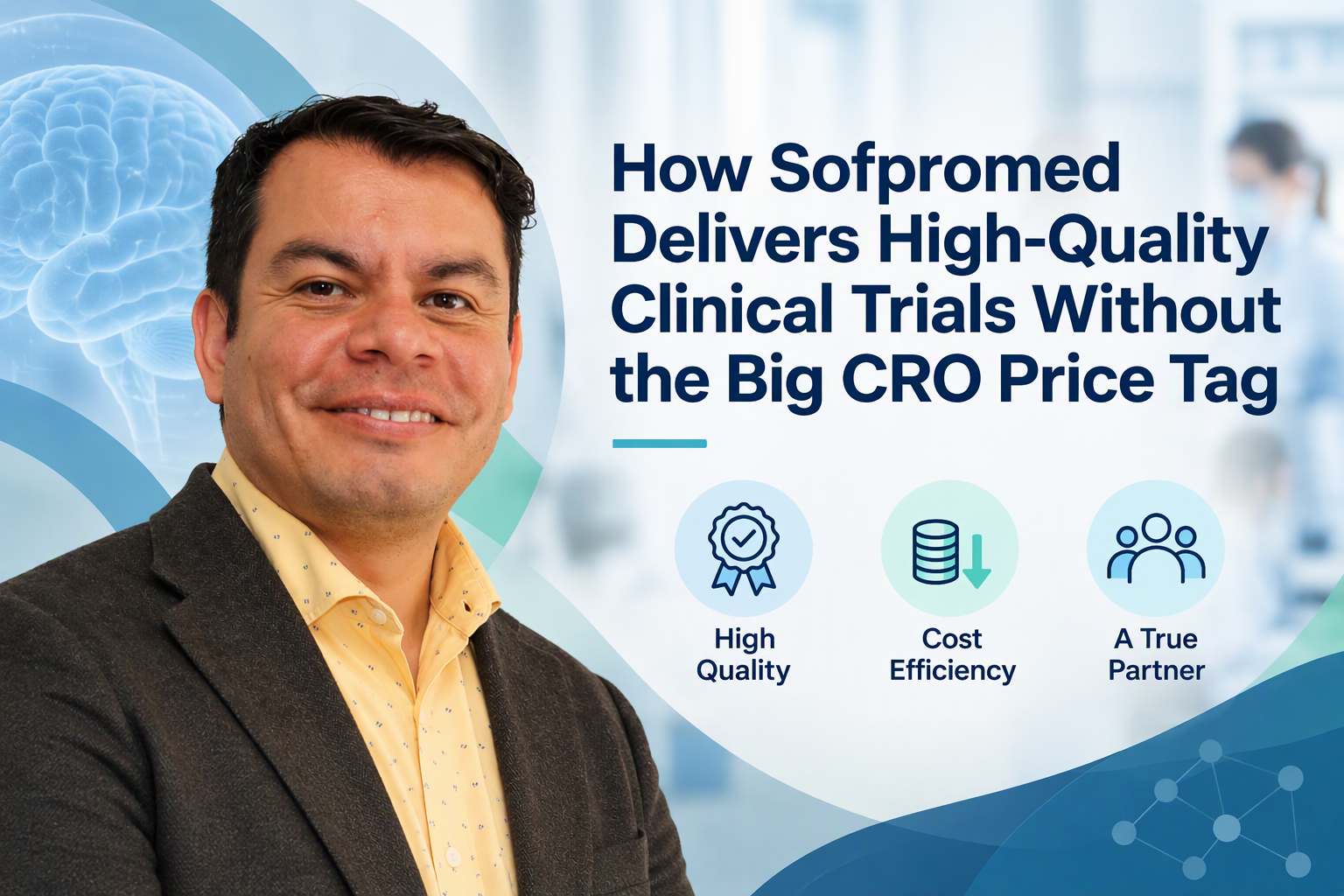
By Patricio Ledesma, Founder & CEO, Sofpromed
If there's one frustration I hear repeatedly from biotech leaders, it's this:
"We need high-quality clinical trial execution, but we simply don't have the budget of a large pharmaceutical company."
And honestly, that's a fair concern.
Table of Contents
Clinical trials have become increasingly expensive.
Many small and mid-sized biotech companies have excellent science, promising compounds, and passionate teams, but they face a major challenge: how do you run a high-quality study without burning through your entire budget before reaching critical milestones?
At Sofpromed, we've spent years solving precisely this problem.
The good news is that lower costs do not automatically mean lower quality.
In fact, I believe one of the biggest misconceptions in our industry is the assumption that spending more always produces better results.
From my experience, that's simply not true.
Quality comes from expertise, smart processes, good oversight, and selecting the right partners.
Cost comes from how efficiently those services are delivered.
Over the years, we've developed a business model that allows us to provide the same high-quality standards expected in international clinical trials while maintaining significantly lower costs than many traditional CROs.
Today I'd like to share the three key strategies that make this possible.
Strategy #1: Running Studies in High-Quality Countries With Lower Operational Costs
Let's start with the biggest opportunity.
When sponsors think about clinical trial costs, they often focus on monitoring, project management, or technology platforms.
But one of the largest cost drivers is actually geography.
Many large CROs automatically propose sites in some of the most expensive countries in the world because that's where they have the largest infrastructure and commercial footprint.
The problem?
Those countries often come with:
- Higher investigator fees
- Higher site budgets
- Higher patient visit costs
- Higher staff salaries
- Higher monitoring expenses
- Higher startup costs
Meanwhile, several countries offer excellent clinical research quality while operating at considerably lower costs.
At Sofpromed, we have extensive experience working in countries such as:
- Spain
- Poland
- Romania
- Bulgaria
- Czech Republic
- Hungary
- Slovakia
- Greece
These countries have highly trained investigators, experienced study coordinators, modern hospitals, and strong regulatory environments.
In many therapeutic areas, including CNS, oncology, rare diseases, and medical devices, the quality is outstanding.
The difference is that operational costs are often substantially lower than in Western Europe or North America.
What This Means for Sponsors
Instead of paying premium rates simply because a site is located in a traditionally expensive region, sponsors can access:
- Equivalent quality
- Experienced investigators
- Strong patient recruitment
- Lower budgets
- Better cost efficiency
The result is simple:
Your funding lasts longer.
And for an emerging biotech company, extending cash runway can be just as important as achieving recruitment goals.
Strategy #2: Reducing Technology Costs Without Sacrificing Compliance
The second area where many studies become unnecessarily expensive is technology.
Years ago, clinical trial technology was limited to a few major providers.
Today, the market is completely different.
There are now many excellent vendors offering:
- EDC systems
- eTMF platforms
- ePRO solutions
- CTMS software
- Safety systems
- Trial management tools
However, many large CROs remain tied to expensive enterprise-level platforms.
Those platforms are often excellent.
But small and mid-size biotech companies frequently end up paying for capabilities they don't actually need.
It's a bit like renting a commercial airliner when you're transporting ten passengers.
The Sofpromed Approach
At Sofpromed, we carefully evaluate each study and select technology based on actual requirements.
We work with validated, compliant platforms that can deliver exactly what the study needs without excessive licensing costs.
For example:
Electronic Data Capture (EDC)
Many sponsors are surprised to discover that modern EDC systems can provide:
- Regulatory compliance
- Audit trails
- Data security
- Monitoring support
- Quality reporting
without the enormous price tag often associated with legacy enterprise systems.
Electronic Trial Master Files (eTMF)
The same principle applies to eTMF solutions.
Sponsors do not necessarily need the most expensive platform in the market.
They need:
- Inspection readiness
- Complete documentation
- Proper access control
- Quality oversight
If a lower-cost system can achieve those objectives while remaining fully compliant, why pay several times more?
Focusing on Value, Not Brand Names
One lesson I've learned throughout my career is that expensive software doesn't automatically improve study quality.
What improves quality is:
- Proper setup
- Proper training
- Proper oversight
- Proper processes
Technology should support quality.
It shouldn't consume a disproportionate share of the clinical development budget.
Strategy #3: A Lean CRO Structure With Far Less Overhead
This is probably the biggest difference between Sofpromed and many larger CROs.
Large organizations have advantages.
They can offer global reach, massive infrastructure, and huge teams.
But that infrastructure comes at a cost.
In many cases, sponsors are indirectly paying for:
- Multiple management layers
- Regional directors
- Department directors
- Vice presidents
- Corporate headquarters
- Extensive internal bureaucracy
By the time a project budget reaches the sponsor, the costs associated with all those layers are already built into the proposal.
Our Lean Model
At Sofpromed, we've intentionally built a different structure.
We focus on:
- Experienced professionals
- Efficient project teams
- Direct communication
- Fewer management layers
- Faster decision making
This creates several benefits.
First, it lowers costs.
Second, it improves responsiveness.
Third, it reduces unnecessary complexity.
Our clients often speak directly with senior operational leaders rather than having messages pass through multiple organizational layers.
Problems get solved faster.
Decisions get made faster.
Projects move faster.
And because we have lower overhead, we don't need to charge the same margin levels that many larger organizations require.
Lower Cost Does Not Mean Lower Quality
This point is extremely important.
When people hear "lower cost," they sometimes assume corners are being cut.
That is not our philosophy.
At Sofpromed, the goal is exactly the opposite.
We focus on removing costs that do not contribute to study quality.
We do not remove:
- Good monitoring
- Quality assurance
- Experienced CRAs
- Regulatory expertise
- Project management excellence
- Investigator support
Those elements are critical.
Instead, we remove inefficiencies.
We ask:
"What expenses truly improve study outcomes, and which ones simply increase the budget?"
When you approach trial execution from that perspective, significant savings become possible.
The Reality for Small Biotechs
I founded Sofpromed because I saw an industry challenge.
Many promising biotech companies struggle to access high-quality clinical development support because traditional models were designed around the budgets of large pharmaceutical organizations.
That doesn't mean smaller companies deserve lower-quality services.
Quite the opposite.
In many cases, emerging biotechs have the most innovative science and the greatest potential to change patient lives.
What they need is a partner that understands the reality of limited budgets.
A partner that actively looks for ways to reduce costs rather than increase them.
A partner that understands every euro or dollar saved today can help fund the next milestone tomorrow.
Final Thoughts
If I had to summarize Sofpromed's cost-efficiency strategy in three points, it would be this:
- Select high-quality countries with lower operational costs
Access excellent investigators and research sites without paying the premium associated with more expensive markets.
- Use cost-effective technology solutions
Choose validated, compliant EDC and eTMF platforms that deliver the required functionality without unnecessary expense.
- Maintain a lean CRO structure
Reduce management layers, overhead costs, and bureaucracy while keeping experienced professionals focused on study execution.
The result is simple:
High-quality clinical trial delivery at a cost that makes sense for biotech companies.
And in today's funding environment, I believe that's more important than ever.
At Sofpromed, our mission isn't just to run clinical trials.
It's to help innovative biotech companies go further with the resources they have, reach important milestones faster, and ultimately bring new therapies to patients more efficiently.