
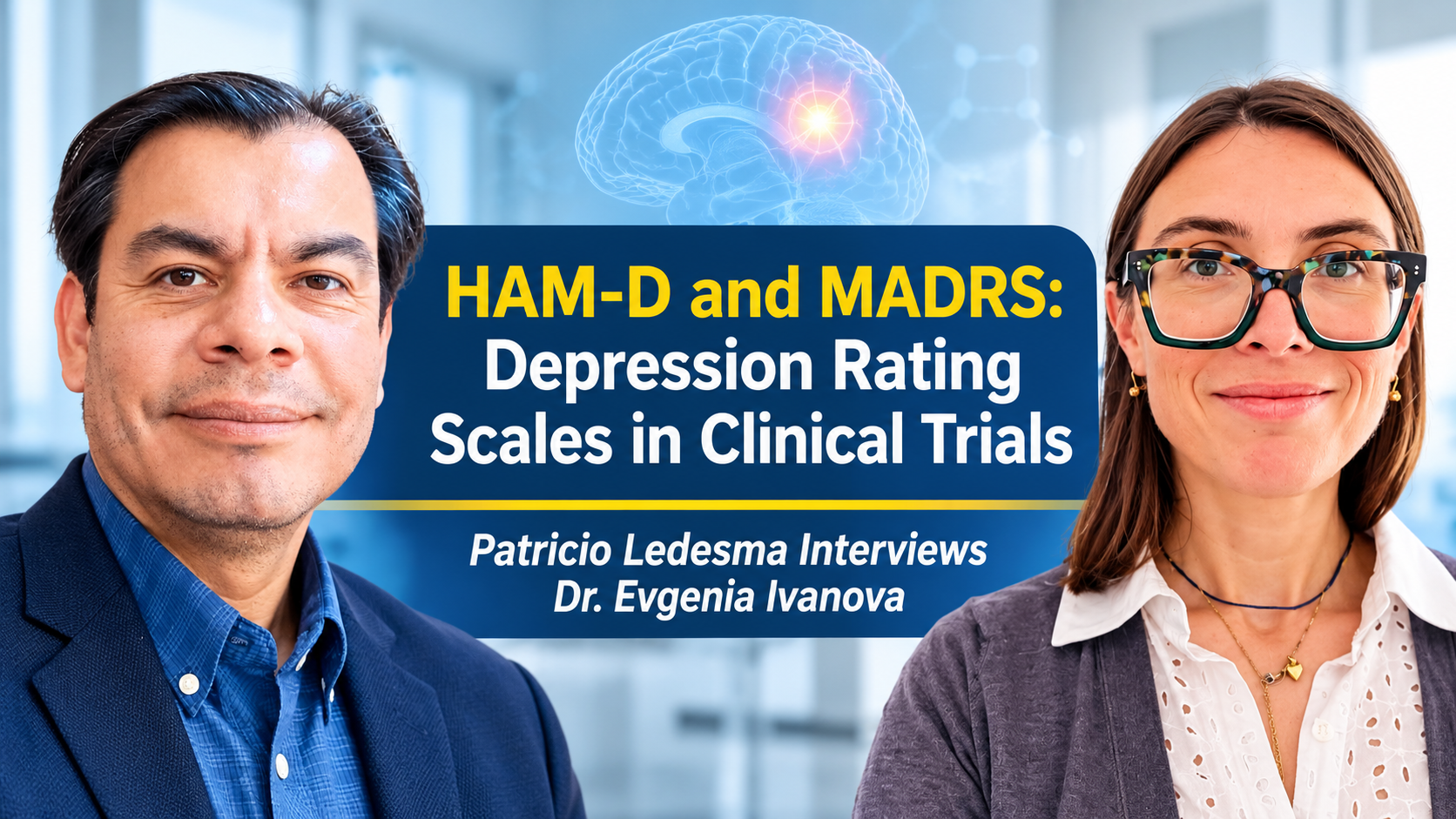
Patricio Ledesma Interviews Dr. Evgenia Ivanova
By Patricio Ledesma, Founder and CEO, Sofpromed
Patricio Ledesma:
Hello everyone, and welcome to today's interview.
I am Patricio Ledesma, and today we will discuss one of the most important topics in CNS clinical research: the quality and consistency of clinician-administered depression rating scales.
These scales are frequently used as primary efficacy endpoints in antidepressant clinical trials.
Two of the most widely used instruments are the Hamilton Depression Rating Scale, or HAM-D/HDRS, and the Montgomery-Åsberg Depression Rating Scale, or MADRS.
Joining me today is Dr. Evgenia Ivanova, an expert in rater training, clinical outcome assessments, and CNS clinical trials.
Evgenia, thank you for being here.
Patricio Ledesma:
The HAM-D and MADRS have been used for decades in depression research. Yet sponsors continue investing heavily in rater training programs. Why is rater training still so important?
Dr. Evgenia Ivanova:
That's an excellent question.
The biggest reason is that these scales are only as reliable as the raters administering them.
Unlike laboratory values or imaging data, depression severity scores depend on clinical interviews and subjective judgment.
Two raters can interview the same patient and arrive at different scores if they interpret responses differently.
This introduces variability.
Excessive variability reduces statistical power.
It can make an effective treatment appear less effective than it truly is.
With the HAM-D, some items require a fair amount of clinical judgment.
Because the interview is semi-structured, raters may ask different follow-up questions, interpret the cause of a symptom differently, or apply the scoring anchors in slightly different ways.
These differences often become more noticeable at the individual-item level.
Structured interview guides, clear scoring conventions, thorough training, and regular calibration help keep raters consistent.
The MADRS was developed specifically to detect changes in depressive symptoms during treatment and to distinguish responders from nonresponders.
But even a scale designed to be sensitive to change depends on how consistently it is administered.
Raters still need to interview participants in a standardized way and apply the scoring anchors consistently so that changes in scores reflect changes in the patient—not differences between raters.
Comprehensive initial training and ongoing calibration are critical for maintaining data quality throughout a study.
Patricio Ledesma:
From a training perspective, what are the most common errors you observe among clinical trial raters when administering HAM-D and MADRS?
Dr. Evgenia Ivanova:
Several patterns appear repeatedly.
The first is insufficient probing.
Patients often give brief or vague answers, and less-experienced raters may assign a score without clarifying the symptom’s frequency, duration, severity, functional impact, and concrete examples.
A related issue is failing to establish the participant’s baseline and the assessment time frame.
Without knowing how the person functioned before the depressive episode, it is difficult to measure meaningful change in sleep, appetite, energy, concentration, and activities.
Raters must also ensure that every score reflects the protocol-defined reference period.
We also see score inflation or compression.
Some raters consistently score too high, while others are overly conservative.
Ratings should be based on documented interview evidence, relevant observations, and the scale anchors—not on an overall impression or assumption.
Scale-specific scoring errors are also common.
On the HAM-D, raters may confuse anhedonia with fatigue or external limitations, base psychomotor ratings on self-report rather than observation, or underrate suicidal ideation when intent or a plan is absent.
On the MADRS, they may fail to separate reported from apparent sadness, confuse lassitude with inability to feel, or blur pessimism with suicidal thinking.
Sleep and appetite are also frequently scored without establishing the participant’s baseline.
Finally, rater drift can occur over time.
Even experienced raters may gradually move away from the original scoring conventions, which is why ongoing calibration and performance monitoring are essential.
Patricio Ledesma:
The HAM-D and MADRS are often used in the same therapeutic area. What unique challenges do raters face with each scale?
Dr. Evgenia Ivanova:
The two scales present somewhat different challenges.
The HAM-D can be challenging because it assesses many types of symptoms—not only depressed mood, but also sleep, anxiety, physical complaints, functioning, and psychomotor changes.
Raters must consider the participant’s baseline and whether medical conditions, medications, anxiety, or situational factors may be contributing to the presentation.
Several items also require observation and clinical judgment, making structured interviewing and calibration particularly important.
The MADRS is shorter and more focused.
Raters must distinguish reported sadness from apparent sadness, carefully assess the severity and persistence of nervousness or inner tension, distinguish lassitude from inability to feel.
Raters must distinguish negative beliefs about oneself or the future from thoughts that life is not worth living or of death and suicide.
They must probe carefully and apply the scoring anchors consistently.
In simple terms, the HAM-D often requires raters to determine what is contributing to a symptom, while the MADRS requires them to distinguish carefully between similar depressive symptoms.
Both scales require standardized training and regular calibration to maintain consistent scoring.
Patricio Ledesma:
In a global multicenter trial, maintaining consistency across countries and sites can be challenging. What best practices have proven most effective?
Dr. Evgenia Ivanova:
Several best practices consistently improve reliability.
First, implement standardized rater certification before enrollment begins.
No rater should conduct efficacy assessments without demonstrating competence.
Second, use structured interview guides.
While clinicians should maintain rapport with patients, standardized questioning helps reduce variability.
Third, conduct periodic calibration exercises.
This allows raters to compare their scoring approaches against expert benchmarks.
Fourth, implement central review procedures when appropriate.
Listening to recorded interviews or reviewing completed ratings can identify inconsistencies early.
Fifth, monitor scoring trends throughout the study.
If a site consistently scores substantially higher or lower than other sites, further evaluation may be required.
Finally, retraining should not be viewed as a corrective action only.
Routine refresher training is one of the most effective methods for preventing rater drift.
Patricio Ledesma:
My final question.
If you could give sponsors only one recommendation when designing depression studies using HAM-D or MADRS, what would it be?
Dr. Evgenia Ivanova:
I would recommend viewing rater quality as a strategic study variable rather than an operational activity.
Many sponsors focus heavily on protocol development and recruitment plans.
Those are obviously important.
However, if endpoint assessments lack consistency, the quality of the efficacy data may suffer.
Investing in rigorous rater selection, certification, calibration, and ongoing quality oversight often delivers a significant return on investment.
A well-trained rater can improve signal detection.
A poorly trained rater can increase noise and variability.
In depression trials, reducing variability is essential.
Ultimately, high-quality rater training contributes directly to study success.
Closing Remarks
Patricio Ledesma:
Evgenia, thank you for sharing your expertise.
Today's discussion highlighted several important lessons for sponsors conducting depression clinical trials.
First, both HAM-D and MADRS require robust rater training.
Second, inter-rater variability remains a major risk to data quality.
Third, ongoing calibration and quality monitoring are just as important as initial certification.
And finally, successful depression studies depend not only on strong science, but also on high-quality endpoint assessments.