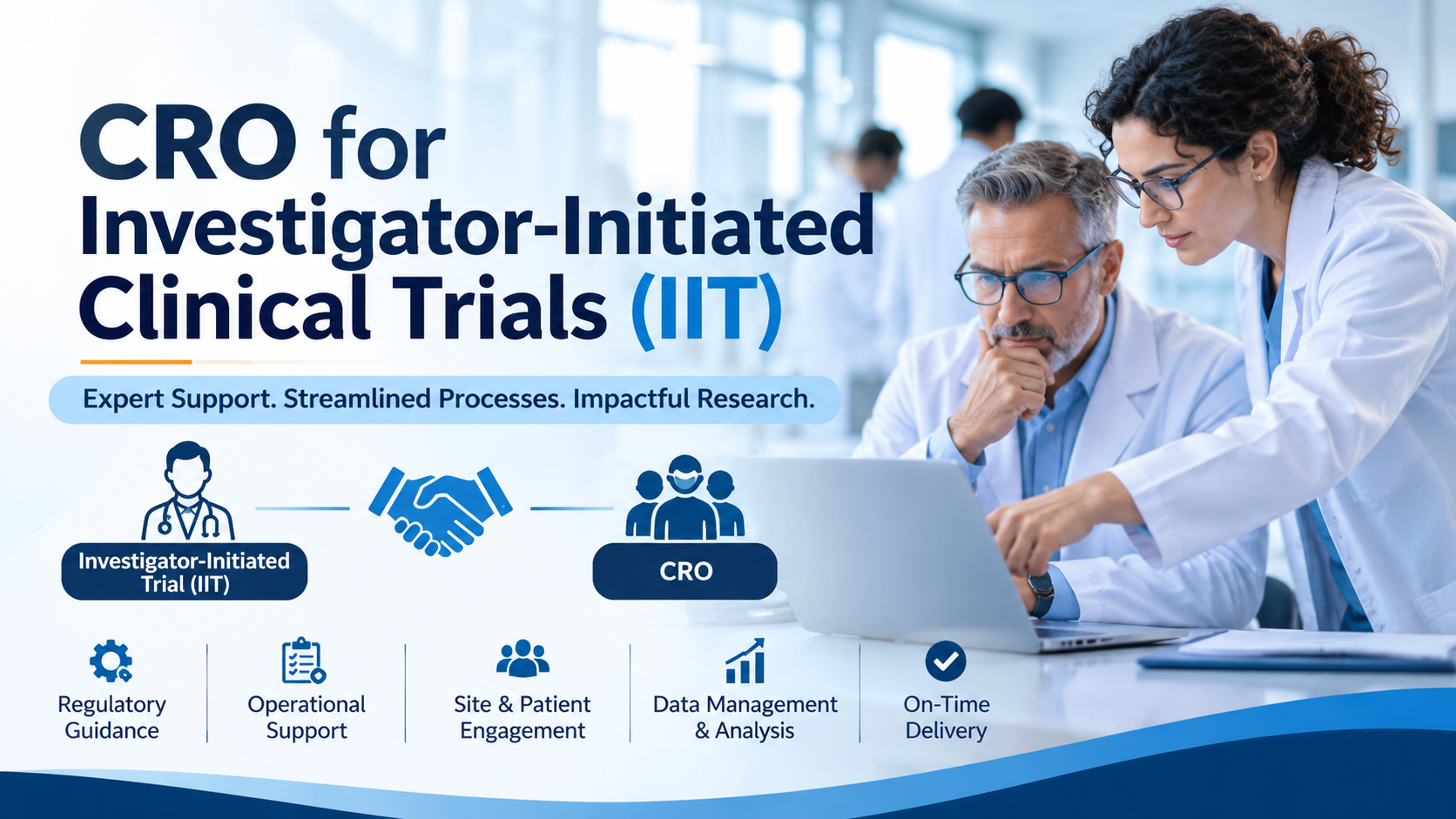
By Patricio Ledesma, Founder and CEO, Sofpromed
Table of Contents
Investigator-Initiated Trials (IITs) play a unique and indispensable role in clinical research.
While pharmaceutical companies sponsor the majority of industry-driven studies, many of the most important scientific questions are answered through investigator-led research conducted by academic institutions, hospitals, cooperative groups, and principal investigators.
Throughout my career in clinical research, I have worked with many academic investigators and research institutions facing the challenge of conducting high-quality clinical trials with limited resources.
Unlike large pharmaceutical companies, academic investigators often operate with small budgets, limited staff, and complex operational constraints.
Yet they are expected to meet exactly the same regulatory and scientific standards.
This is where experienced CRO support becomes critical.
At Sofpromed, we have extensive experience supporting Investigator-Initiated Trials across multiple therapeutic areas, particularly oncology.
Our teams understand the unique realities of IITs, including budget limitations, grant-funded research, academic governance structures, and the need for flexible, cost-effective clinical trial support.
In this article, I will discuss the growing importance of Investigator-Initiated Trials, the challenges faced by academic sponsors, best practices for successful oncology IITs, and how Sofpromed helps investigators bring innovative research ideas to life.
What Is an Investigator-Initiated Trial?
An Investigator-Initiated Trial is a clinical study in which the sponsor is an investigator, academic institution, hospital, university, or research consortium rather than a pharmaceutical or biotechnology company.
In an IIT, the Principal Investigator typically assumes sponsor responsibilities that may include:
- Protocol development
- Regulatory submissions
- Safety oversight
- Data management
- Monitoring oversight
- Statistical analysis
- Final publication
The investigator is responsible for ensuring compliance with:
- ICH E6(R3) Good Clinical Practice
- FDA regulations
- EU Clinical Trial Regulation (CTR)
- Local ethics committee requirements
- Data protection regulations
While many IITs receive financial support, study medication, or grants from pharmaceutical companies, the scientific control usually remains with the investigator.
Why Investigator-Initiated Trials Are Important
Many important medical advances originate from investigator-driven research.
Unlike industry-sponsored studies, IITs are often designed to answer questions that may have limited commercial value but substantial clinical importance.
Examples include:
- Comparative effectiveness studies
- Optimization of treatment schedules
- Biomarker validation programs
- Rare disease research
- Academic oncology collaborations
- Real-world evidence studies
- Combination therapy investigations
- Supportive care interventions
These studies frequently influence treatment guidelines and clinical practice worldwide.
Table 1. Key Differences Between Industry Trials and IITs
|
Characteristic |
Industry Trial |
Investigator-Initiated Trial |
|
Sponsor |
Pharmaceutical company |
Investigator or academic institution |
|
Primary objective |
Regulatory approval |
Scientific or clinical question |
|
Funding source |
Corporate budget |
Grants, foundations, institutions |
|
Resources |
Extensive |
Often limited |
|
Operational support |
Internal departments |
Often outsourced |
|
Publication rights |
Sponsor-controlled |
Investigator-led |
|
Study flexibility |
Moderate |
Often higher |
IITs often address clinically meaningful questions that would otherwise remain unanswered.
The Global Importance of Investigator-Initiated Research
Academic research continues to drive innovation globally.
Leading oncology breakthroughs have frequently emerged from investigator-led studies conducted by organizations such as:
- Memorial Sloan Kettering Cancer Center
- MD Anderson Cancer Center
- Dana-Farber Cancer Institute
- Mayo Clinic
- European Organisation for Research and Treatment of Cancer (EORTC)
- National Cancer Institute (NCI)
These institutions routinely conduct IITs that shape future standards of care.
Table 2. Typical Contributions of IITs to Clinical Research
|
Area |
Contribution |
|
Oncology |
New treatment strategies |
|
Rare Diseases |
Generation of critical evidence |
|
Biomarkers |
Validation studies |
|
Precision Medicine |
Patient selection approaches |
|
Academic Innovation |
Early proof-of-concept research |
|
Combination Therapies |
Exploratory clinical evaluation |
|
Real-World Evidence |
Practical treatment insights |
Many therapies currently considered standard of care were supported by academic studies long before industry sponsors pursued larger registration programs.
Why Oncology IITs Are Especially Important
Oncology represents one of the strongest areas of investigator-led research.
Cancer investigators continually seek answers to questions such as:
- How can existing therapies be optimized?
- Which biomarkers predict response?
- Can approved drugs be used in new indications?
- What combinations may improve outcomes?
- Can toxicity be reduced?
These questions often emerge first in academic settings.
Table 3. Common Oncology IIT Objectives
|
Objective |
Example |
|
Biomarker research |
ctDNA monitoring |
|
Treatment sequencing |
Optimal line selection |
|
Dose optimization |
Reduced toxicity regimens |
|
Combination therapies |
Immunotherapy combinations |
|
Rare cancers |
Small population studies |
|
Translational research |
Molecular profiling studies |
|
Real-world validation |
Standard of care evaluation |
Academic oncology investigators frequently lead innovations that later become industry-sponsored programs.
Key Challenges Faced by IIT Sponsors
Although IITs are scientifically valuable, they face significant operational challenges.
Limited Budgets
The most common challenge is funding.
Unlike pharmaceutical companies, academic investigators frequently rely on:
- Government grants
- Cancer foundations
- Public funding agencies
- Institutional resources
- Charitable organizations
Budgets are often a fraction of those available to industry-sponsored trials.
Table 4. Typical IIT Operational Constraints
|
Challenge |
Impact |
|
Limited funding |
Reduced staffing |
|
Small operations teams |
Increased workload |
|
Limited monitoring resources |
Compliance risks |
|
Complex contracts |
Delayed startup |
|
Academic timelines |
Slower decision-making |
|
Limited data management support |
Database risks |
|
Statistical resource limitations |
Analysis delays |
These constraints can significantly affect study success if not properly managed.
Regulatory Requirements Are the Same
One of the greatest misconceptions regarding investigator-led studies is that they face fewer regulatory requirements.
In reality, regulators expect the same level of compliance.
Investigators must ensure:
- Good Clinical Practice compliance
- TMF maintenance
- Safety reporting
- Monitoring oversight
- Protocol adherence
- Data integrity
- Quality management
Whether the study budget is €200,000 or €20 million, compliance expectations remain essentially identical.
This makes experienced CRO support particularly valuable.
Why Academic Investigators Need CRO Support
Most investigators are experts in medicine and science.
Very few are experts in:
- Trial management
- Monitoring
- Regulatory affairs
- Data management
- Statistics
- Quality assurance
Attempting to build these capabilities internally can be extremely expensive.
Instead, many institutions partner with specialized CROs.
An experienced CRO can provide:
- Infrastructure
- Expertise
- Technology
- Regulatory knowledge
without requiring permanent institutional investment.
How Sofpromed Supports Investigator-Initiated Trials
At Sofpromed, we understand that IITs require a very different operational model than large pharmaceutical studies.
Academic sponsors need:
- Flexibility
- Scientific collaboration
- Cost-effective solutions
- Senior expertise
- Efficient execution
Our approach is specifically designed to meet these needs.
Study Design and Protocol Development
The success of an IIT often begins with protocol design.
Our teams support investigators with:
- Endpoint selection
- Feasibility assessment
- Sample size assumptions
- Statistical methodology
- Study operational planning
This early support helps prevent costly amendments later.
Clinical Data Management
Many IITs underestimate the complexity of data management.
A properly designed database can significantly improve study quality.
Sofpromed supports:
- EDC setup
- eCRF design
- Edit checks
- Data review plans
- Data cleaning
- Database lock preparation
For academic studies, efficient database design can save both time and budget.
Biostatistics and Statistical Programming
This is one area where academic sponsors often need substantial support.
Our biostatistics teams assist with:
- Statistical Analysis Plans (SAPs)
- Sample size calculations
- Randomization design
- Interim analyses
- Final study reporting
We also provide:
- SDTM datasets
- ADaM datasets
- TLF generation
- Regulatory-compliant outputs
These services ensure high-quality scientific results while maintaining budget efficiency.
Clinical Monitoring Support
Monitoring remains essential for data quality and patient safety.
Sofpromed can support:
- Site initiation visits
- Routine monitoring visits
- Remote monitoring
- Source data verification
- Site closeout activities
We tailor monitoring intensity according to study risk and available funding.
This is especially important in IIT environments where resources are limited.
Medical Writing Support
Academic investigators frequently need assistance preparing:
- Study protocols
- Investigator brochures
- Clinical Study Reports
- Conference abstracts
- Manuscripts
Our medical writing teams help ensure scientific clarity and regulatory compliance.
Best Practices for a Successful Oncology IIT
After supporting multiple oncology studies throughout my career, I have observed several best practices that consistently improve outcomes.
1. Start with a Clinically Relevant Question
The strongest IITs address questions that matter directly to patient care.
Examples include:
- Biomarker-guided treatment decisions
- Treatment sequencing
- Combination optimization
- Rare tumor management
Scientific relevance drives recruitment and publication success.
2. Keep Study Design Realistic
Overly ambitious IITs frequently struggle.
Instead of pursuing dozens of exploratory endpoints, focus on:
- One primary endpoint
- Limited secondary endpoints
- Clear analysis objectives
A focused study is often more successful than an overly complex one.
3. Build Statistical Expertise Early
Statistical planning should begin before protocol finalization.
Common mistakes include:
- Underpowered studies
- Inappropriate endpoints
- Unrealistic assumptions
Early biostatistical involvement helps avoid these risks.
4. Select Investigators Carefully
Recruitment performance often determines study success.
High-performing oncology sites generally have:
- Experienced research coordinators
- Dedicated investigators
- Strong patient populations
- Established trial infrastructure
Site selection is one of the most important decisions in any IIT.
5. Prioritize Data Quality
Publications, conference presentations, and future funding depend on reliable data.
Best practices include:
- Early edit checks
- Risk-based monitoring
- Timely query resolution
- Consistent data review
High-quality data ultimately saves time and money.
6. Develop a Publication Strategy
Publication planning should begin before enrollment.
Consider:
- Target journals
- Conference presentations
- Authorship strategy
- Data cut timelines
Successful IITs are not measured only by completion but also by dissemination of results.
Why Sofpromed Is Well Positioned to Support IITs
Our experience has shown that academic studies require a unique mindset.
Large CRO models designed for multinational pharmaceutical studies are not always suitable for grant-funded research.
At Sofpromed, we have built our approach around:
Scientific Collaboration
We work closely with investigators and academic institutions as partners rather than vendors.
Cost Efficiency
We understand budget constraints.
Our lean operational model helps maximize available funding.
Flexible Resource Allocation
Investigators can access only the services they need.
Examples include:
- Statistics only
- Data management only
- Monitoring only
- Full-service support
Senior Expertise
Many IITs cannot afford multiple management layers.
Our model provides direct access to experienced professionals.
Supporting Global Academic Research
Modern IITs increasingly involve multiple countries.
Academic institutions may conduct studies across:
- Europe
- North America
- Asia-Pacific
- Latin America
Sofpromed can support multinational academic programs through:
- Regulatory coordination
- Data management
- Monitoring
- Biostatistics
- Project management
This allows investigators to expand research beyond single-center studies and generate broader evidence.
The Future of Investigator-Initiated Trials
I believe the importance of IITs will continue to grow during the coming decade.
Several trends support this view:
Table 5. Future Drivers of IIT Growth
|
Trend |
Expected Impact |
|
Precision Oncology |
Very High |
|
Biomarker Development |
Very High |
|
Rare Cancer Research |
High |
|
Academic Collaborations |
High |
|
Real-World Evidence |
High |
|
Artificial Intelligence |
Growing |
|
Translational Medicine |
Very High |
Many of tomorrow's innovations will originate from academic investigators asking scientific questions that extend beyond traditional commercial objectives.
IITs will continue to play a critical role in generating these answers.
Conclusion
Investigator-Initiated Trials remain one of the most important engines of innovation in clinical research.
They allow academic investigators, hospitals, and research institutions to answer critical scientific questions that may not be addressed through traditional pharmaceutical development programs.
However, conducting successful IITs requires overcoming significant challenges, including limited funding, complex regulations, operational constraints, and increasing expectations regarding data quality and compliance.
Having spent many years working in clinical research, I have seen firsthand how the right operational support can transform an ambitious research idea into a successful study capable of influencing clinical practice and improving patient outcomes.
At Sofpromed, we are proud to support Investigator-Initiated Trials with flexible, cost-effective services tailored to the realities of academic research.
Our experience in oncology, data management, biostatistics, statistical programming, monitoring, medical writing, and project management allows us to help investigators conduct high-quality studies without the overhead often associated with large commercial CRO structures.
Whether supporting a single-center oncology trial, a multi-country academic collaboration, or a complex biomarker-driven precision medicine study, our objective remains the same: helping investigators generate robust scientific evidence efficiently, compliantly, and within budget.
As IITs continue to drive innovation across oncology and many other therapeutic areas, we look forward to partnering with academic investigators and institutions worldwide to bring the next generation of medical discoveries to patients.