By Patricio Ledesma, Founder and CEO, Sofpromed
Table of Contents
Over the past two decades, Singapore has quietly transformed itself into one of the world's most sophisticated biotechnology and biomedical research hubs.
While countries such as the United States, China, Germany, and the United Kingdom often receive most of the attention, Singapore has steadily built an ecosystem that combines scientific excellence, regulatory efficiency, advanced infrastructure, government support, and international collaboration.
Today, Singapore is increasingly viewed as one of the most attractive locations for biotechnology innovation in Asia.
Its biotech sector continues to grow, attracting venture capital, multinational pharmaceutical investment, and world-class scientific talent.
More importantly, Singapore-based biotech companies are expanding internationally and conducting clinical trials across North America, Europe, and Asia-Pacific.
As someone who has spent many years working within the clinical research industry, I see Singapore as one of the most strategically positioned biotech ecosystems in the world.
The country's combination of innovation, regulatory credibility, and global connectivity places it in an excellent position to become an even more influential player in international drug development.
At Sofpromed, we have experience supporting innovative biotechnology companies conducting international clinical trials.
This has given us valuable insight into the specific operational, regulatory, and budgetary requirements faced by Singapore-based biotech sponsors as they expand globally.
Our teams understand how to help these organizations efficiently conduct clinical trials across North America, Europe, and Asia-Pacific while maintaining high quality standards and controlling costs.
How Singapore Built a World-Class Biotech Ecosystem
Singapore's emergence as a biotechnology leader did not happen by accident.
For more than twenty years, the Singapore government has invested heavily in life sciences infrastructure, biomedical research, advanced manufacturing, and clinical research capabilities.
Organizations such as:
- Agency for Science, Technology and Research (A*STAR)
- National University of Singapore (NUS)
- Duke-NUS Medical School
- National Cancer Centre Singapore
- Singapore General Hospital
- National University Hospital
have played important roles in creating an innovation-focused ecosystem.
Unlike larger countries that rely on domestic market size, Singapore has built its biotech strategy around international excellence.
From the beginning, the focus has been on creating globally competitive companies capable of developing innovative therapies for worldwide markets.
Today, many multinational pharmaceutical companies maintain significant operations in Singapore, including:
- Pfizer
- Roche
- Novartis
- AstraZeneca
- Merck
- GSK
- Sanofi
- Takeda
- Amgen
Their presence has helped create a highly experienced workforce and strong clinical development infrastructure.
Singapore's Biotechnology Market Continues to Expand
Singapore's biotechnology and biomedical sciences sector has expanded steadily over the last decade.
Several factors continue to drive growth:
- Government investment
- Growing venture capital activity
- Strong intellectual property protection
- Attractive tax framework
- Access to highly educated talent
- Strategic position within Asia-Pacific
Table 1. Key Characteristics of the Singapore Biotech Ecosystem
|
Indicator |
Description |
|
Population |
Approximately 6 million |
|
Regulatory Agency |
Health Sciences Authority (HSA) |
|
Key Research Organizations |
A*STAR, Duke-NUS, NUS |
|
Clinical Research Reputation |
High-quality, internationally recognized |
|
Intellectual Property Protection |
Among the strongest in Asia |
|
Strategic Position |
Gateway to Southeast Asia |
|
Language Advantage |
English-speaking research environment |
|
GMP Manufacturing Presence |
Strong biologics and cell therapy capabilities |
These characteristics make Singapore especially attractive for biotechnology startups seeking international expansion.
Why Investors Like Singapore Biotechs
Singapore biotechnology companies benefit from several competitive advantages.
Strong Government Support
Government initiatives continue to support:
- Drug discovery
- Translational medicine
- Cell therapy
- Gene therapy
- Artificial intelligence in healthcare
- Precision medicine
Excellent Intellectual Property Protection
Biotech investors value strong patent protection.
Singapore consistently ranks among the strongest countries in Asia for intellectual property enforcement.
International Regulatory Credibility
The Health Sciences Authority (HSA) is highly respected internationally.
Data generated in Singapore is generally accepted by major regulators and frequently incorporated into global development programs.
Major Therapeutic Areas of Innovation
Singapore biotechs are active across multiple therapeutic areas.
Table 2. Major Areas of Singapore Biotech Innovation
|
Therapeutic Area |
Growth Potential |
|
Oncology |
Very High |
|
Cell Therapy |
Very High |
|
Gene Therapy |
High |
|
Rare Diseases |
High |
|
Immunology |
High |
|
Neurology |
Moderate to High |
|
Infectious Diseases |
High |
|
Precision Medicine |
Very High |
Particularly notable is Singapore's growing leadership in advanced therapies, including:
- CAR-T treatments
- Cell-based therapeutics
- Precision oncology
- Biomarker-driven drug development
- Translational medicine programs
Singapore's Role in Global Clinical Development
Historically, many Singapore biotechnology companies focused primarily on regional development programs.
That is changing rapidly.
Today, Singapore-based sponsors increasingly pursue:
- FDA approvals
- EMA approvals
- PMDA approvals in Japan
- TGA approvals in Australia
- Global commercialization strategies
As a result, multinational clinical trials are becoming increasingly important.
Many Singapore biotech companies now design clinical development plans with worldwide expansion in mind from the beginning.
Expansion into North America
For most biotechnology companies worldwide, North America remains the most important commercial market.
Singapore biotech executives increasingly seek:
- FDA interactions
- IND submissions
- US clinical sites
- American key opinion leaders
- Registration-enabling studies
Table 3. Why Singapore Biotechs Conduct US Clinical Trials
|
Objective |
Benefit |
|
FDA approval pathway |
Access to the world's largest pharmaceutical market |
|
Scientific credibility |
Increased investor confidence |
|
KOL engagement |
Stronger commercial positioning |
|
Access to specialized centers |
Improved recruitment quality |
|
Strategic partnerships |
Licensing opportunities |
Particularly in oncology and rare diseases, participation by major American institutions can significantly increase global recognition of a development program.
Expansion into Europe
Europe represents another important destination for Singapore biotech sponsors.
The European market offers:
- Large patient populations
- Strong regulatory credibility
- High-quality investigators
- Broad therapeutic expertise
Countries commonly selected include:
- Germany
- Spain
- France
- Italy
- Belgium
- Netherlands
- Poland
- Czech Republic
The implementation of CTIS under the Clinical Trials Regulation has simplified aspects of multinational trial management throughout Europe.
Table 4. Benefits of European Clinical Research
|
Factor |
Advantage |
|
Diverse populations |
More representative clinical data |
|
Strong oncology networks |
Faster recruitment |
|
CTIS framework |
Regulatory harmonization |
|
Academic excellence |
High-quality investigators |
|
EMA pathway |
Access to European approval |
For Singapore biotech companies, Europe often provides an excellent balance between scientific quality and recruitment efficiency.
Expansion Across Asia-Pacific
Singapore companies possess a natural advantage within the Asia-Pacific region.
Many already have established relationships across neighboring countries.
Common expansion destinations include:
- Australia
- Japan
- South Korea
- Taiwan
- Malaysia
- Thailand
- Hong Kong
- New Zealand
Table 5. Asia-Pacific Clinical Development Strategy
|
Country |
Typical Use Case |
|
Australia |
First-in-human and Phase I studies |
|
Japan |
Registration studies |
|
South Korea |
Oncology programs |
|
Taiwan |
Multiregional studies |
|
Malaysia |
Cost-efficient recruitment |
|
Thailand |
Large patient populations |
|
New Zealand |
Early phase development |
These countries often become integral components of multinational trial programs.
Why Singapore Biotechs Are Increasingly Conducting Global Trials
Several strategic reasons explain this trend.
1. Global Commercialization Goals
Most innovative therapies require international market access to maximize commercial value.
2. Investor Expectations
Global investors increasingly expect companies to demonstrate worldwide development plans.
3. Licensing Opportunities
Large pharmaceutical companies prefer products supported by international clinical data.
4. Regulatory Requirements
Some indications require broader population representation to support global submissions.
5. Faster Recruitment
Multinational studies can significantly reduce enrollment timelines.
Challenges Faced by Singapore Biotech Sponsors
Despite their strengths, Singapore biotech companies face many of the same challenges encountered by biotechnology organizations globally.
Regulatory Complexity
Managing interactions with multiple agencies can be challenging.
Sponsors may need to coordinate requirements from:
- FDA
- EMA
- MHRA
- PMDA
- TGA
- HSA
Each authority has unique expectations.
Budget Pressures
While venture funding exists, investors increasingly focus on:
- Capital efficiency
- Development timelines
- Resource utilization
- Cost control
Biotech companies seek partners who can support efficient execution.
Operational Management
Global studies require coordination across:
- Sites
- Countries
- Vendors
- CROs
- Laboratories
- Data systems
This complexity increases rapidly as programs expand.
The Importance of Cost-Efficient Clinical Development
Many biotechnology companies have learned an important lesson over the last few years.
Raising capital is difficult.
Preserving capital is equally important.
Sponsors increasingly focus on:
- Lower operational costs
- Faster timelines
- Better project oversight
- Flexible outsourcing models
This trend is particularly visible among emerging biotechnology organizations.
Running a global trial does not have to require the overhead associated with large multinational CRO structures.
Many sponsors now prefer leaner operational models with experienced senior teams.
How Sofpromed Supports Singapore Biotechs Globally
At Sofpromed, we understand the challenges faced by innovative biotechnology companies seeking international expansion.
We have experience supporting sponsors conducting studies across multiple regions and understand the unique requirements that biotechnology companies encounter when expanding beyond their home markets.
Our objective is straightforward:
Help sponsors execute high-quality clinical trials efficiently and cost-effectively.
Global Clinical Operations
We support activities such as:
- Clinical project management
- Site identification
- Feasibility assessments
- Site activation
- Monitoring
- Vendor oversight
- Trial master file management
- Risk management
This support allows sponsors to focus on strategy and innovation while maintaining operational excellence.
Data Management and Biostatistics
Data quality remains critical for regulatory success.
Sofpromed can support:
- Database design
- EDC implementation
- Clinical data management
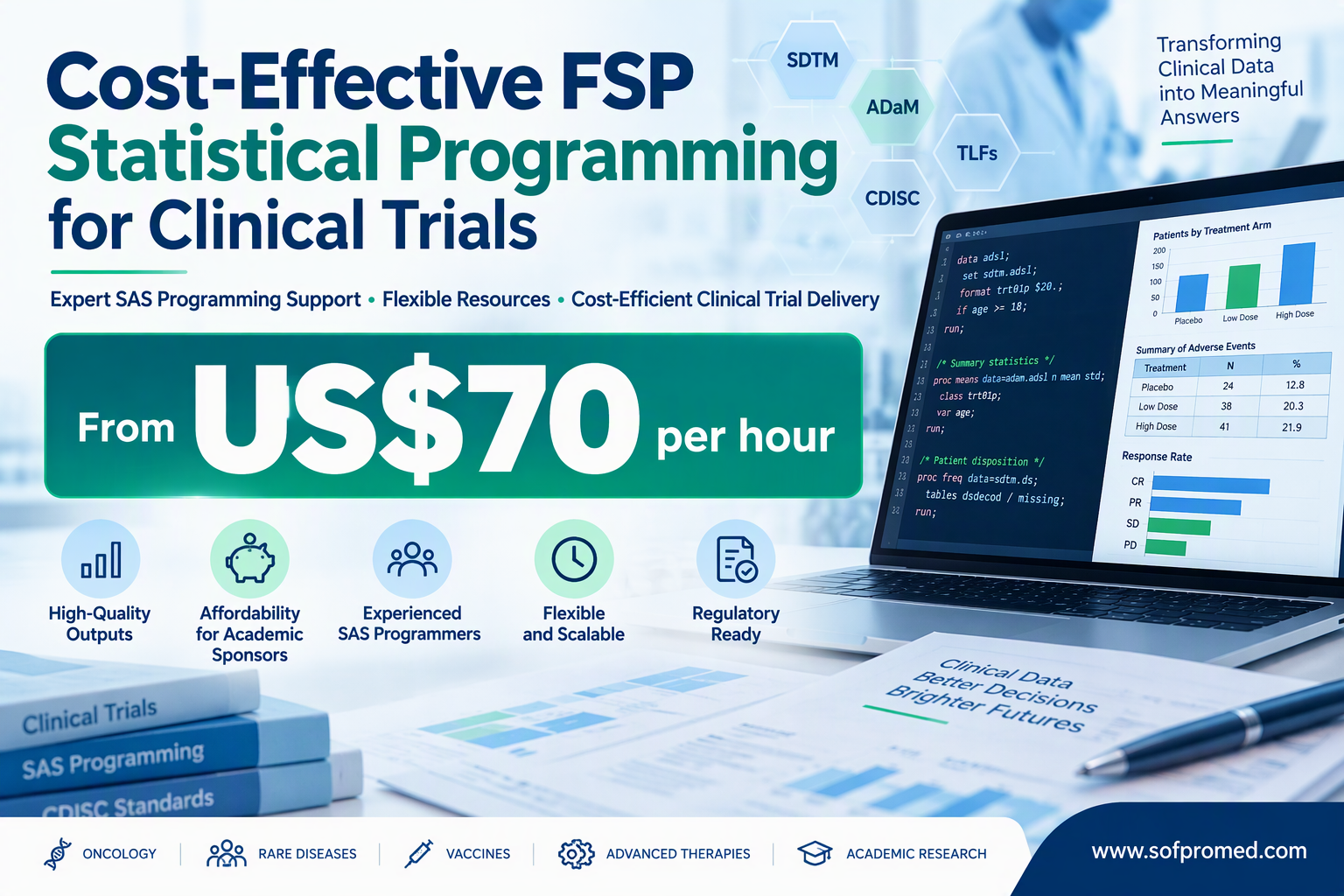
- Statistical programming
- Biostatistics
- SDTM conversion
- ADaM datasets
- Regulatory reporting
These capabilities are particularly valuable for biotechnology companies conducting international studies intended for regulatory submissions.
Regulatory Support
Singapore biotech sponsors frequently require support for multinational submissions.
We can assist with:
- FDA-related activities
- European CTIS submissions
- Ethics committee submissions
- Regulatory coordination
- Clinical study documentation
This helps reduce administrative burden and accelerates study startup.
Flexible Resource Models
Not every sponsor requires a full-service CRO solution.
Many biotechnology companies prefer flexible models.
Examples include:
- Functional Service Provider (FSP)
- Embedded teams
- Hybrid outsourcing
- Study-specific support
- Statistical programming services
- Clinical monitoring services
These approaches can improve efficiency while reducing unnecessary overhead.
Competitive Pricing
One topic frequently raised by emerging biotechnology companies is cost management.
Global clinical development is expensive.
Sponsors need partners who understand financial realities.
Because Sofpromed operates with a flexible structure and highly experienced teams, we can often provide cost-efficient support compared with larger traditional CRO models.
This is especially valuable for Singapore biotech companies seeking to optimize investment capital while expanding internationally.
Understanding the Needs of Singapore Biotech Companies
Working effectively with Singapore sponsors requires more than technical expertise.
It requires understanding:
- Fast decision-making processes
- Innovation-driven cultures
- International ambitions
- Venture capital expectations
- Scientific rigor
Singapore biotechnology companies are often highly sophisticated organizations with global aspirations from their earliest stages.
As a result, they need partners capable of operating internationally while remaining responsive and efficient.
At Sofpromed, our experience supporting international biotechnology organizations allows us to align with these expectations and provide practical solutions tailored to each sponsor's needs.
The Future of Singapore Biotech
The outlook for Singapore biotechnology remains extremely promising.
Several trends are likely to accelerate over the next decade:
Table 6. Future Growth Drivers
|
Trend |
Expected Impact |
|
Precision medicine |
Very High |
|
Cell therapy |
Very High |
|
Gene therapy |
High |
|
AI in drug development |
High |
|
Rare disease programs |
High |
|
Global clinical trials |
Very High |
|
Strategic licensing activities |
Very High |
Singapore's strengths in scientific excellence, regulatory credibility, intellectual property protection, and international collaboration position the country to play an increasingly important role in worldwide drug development.
While it may not match the scale of the United States or China, Singapore has the potential to become one of the most influential biotechnology ecosystems per capita anywhere in the world.
Conclusion
Singapore has successfully transformed itself into a globally respected biotechnology and clinical research hub.
Through sustained investment in science, innovation, infrastructure, and talent, the country has created an ecosystem capable of competing on the international stage.
Today, Singapore biotech companies are increasingly conducting multinational clinical trials across North America, Europe, and Asia-Pacific.
They are pursuing FDA and EMA approvals, partnering with global pharmaceutical companies, and developing innovative therapies in areas such as oncology, cell therapy, gene therapy, immunology, and rare diseases.
As these organizations continue their international expansion, they require reliable partners capable of supporting efficient global clinical development.
At Sofpromed, we understand the operational, regulatory, and commercial challenges that Singapore biotechnology companies face as they grow internationally.
Our experience supporting global clinical research programs helps us provide practical, flexible, and cost-effective solutions across North America, Europe, and Asia-Pacific.
By combining scientific rigor, operational efficiency, and competitive pricing, we help innovative sponsors bring promising therapies to patients around the world faster and more efficiently.
As Singapore's biotech sector continues its remarkable growth trajectory, we look forward to supporting the next generation of biotech innovators on their journey toward global success.