
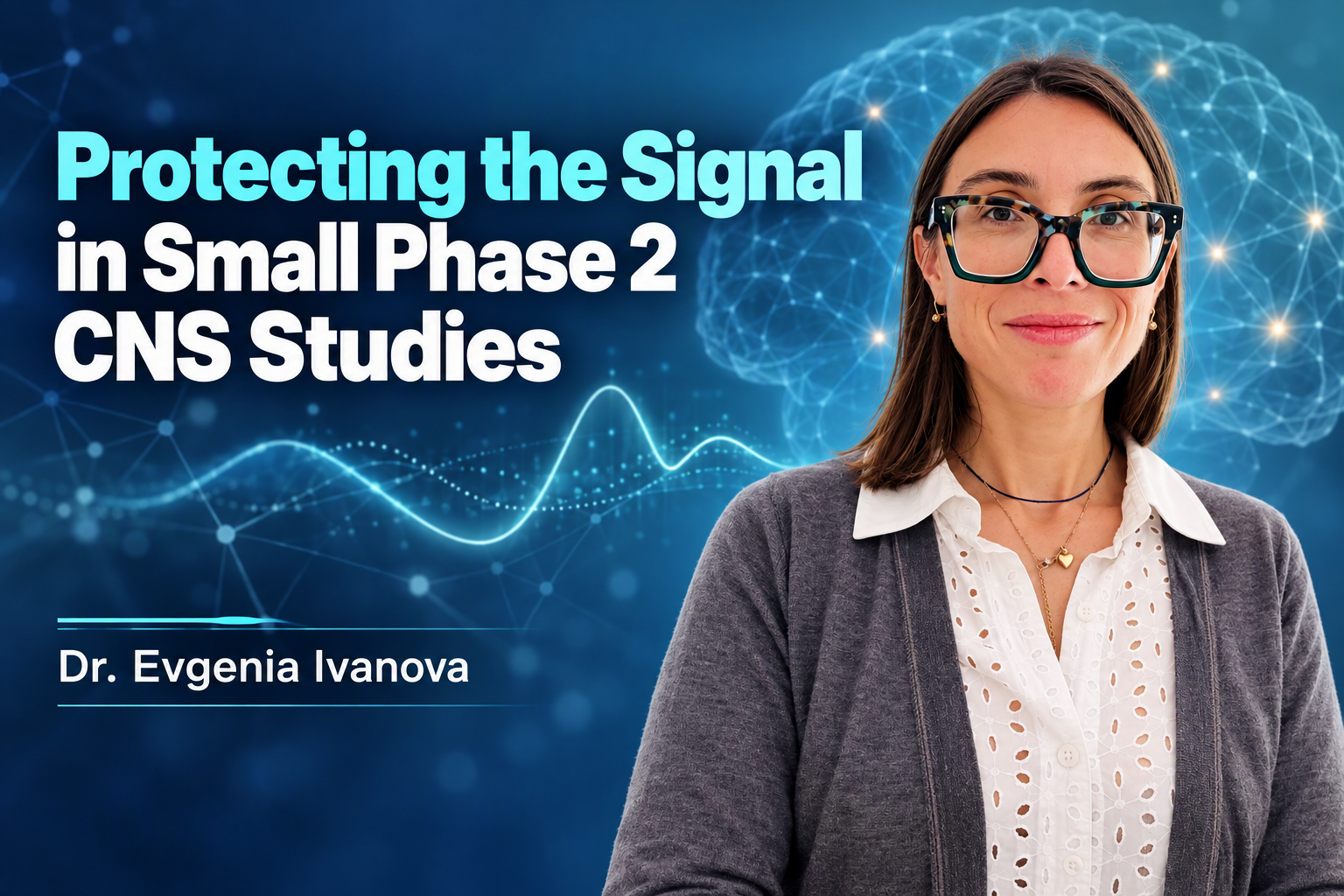
Why study-specific rater training is central to endpoint quality, signal detection, and clinical development decisions
By Dr. Evgenia Ivanova – CNS Rater Training Expert
Table of Contents
This article is intended for biotechnology companies, clinical development leaders, medical directors, and study teams planning small Phase 2 CNS trials.
In these programs, every participant and every assessment can meaningfully influence the dataset, making rater competency an important part of the scientific strategy rather than a purely operational requirement.
Why every assessment carries more weight
With limited sample sizes, a relatively small number of inconsistent interviews or poorly supported scores may introduce enough variability to obscure, exaggerate, or distort an emerging treatment signal.
The consequences may extend beyond an individual rating: variability can influence the estimated treatment effect, the apparent relationship between dose and response where multiple doses are studied, and the decision about whether or how the program should proceed.
High-quality rater training should therefore be viewed as part of the study’s endpoint-quality and signal-detection strategy.
By reducing avoidable measurement error, it strengthens confidence that observed clinical changes are being captured consistently rather than being driven by differences in interviewing or scoring practices.
Different challenges in Phase 2 and Phase 3
Table 1: Challenges in Phase 2 and Phase 3 CNS studies
|
Study consideration |
Small Phase 2 CNS study |
Larger Phase 3 CNS study |
|---|---|---|
|
Primary question |
Is there credible preliminary evidence of efficacy, and what dose, endpoint strategy, or design should advance into confirmatory development? |
Can efficacy be confirmed and the benefit–risk profile adequately characterized in a larger population? |
|
Effect of variability |
Because the sample is relatively small, a limited number of inconsistent assessments may materially affect the apparent treatment signal or dose–response relationship. |
Variability across numerous raters, sites, countries, languages, and visits may increase measurement noise or introduce systematic bias. |
|
Training priority |
Individual rater competency, study-specific interviewing and scoring, understanding of the endpoint, defensible scoring rationale, and early correction of weaknesses. |
Standardization at scale, combined with ongoing performance surveillance, calibration, targeted remediation, and management of rater drift. |
Both phases require strong training, but the emphasis differs.
Phase 2 requires particularly close attention to each rater's interviewing, scoring, and clinical reasoning.
Phase 3 places greater emphasis on maintaining standardization across a larger international network over time.
Certification is only the starting point
Passing a knowledge test or scoring within an acceptable range does not necessarily demonstrate that a rater can conduct a high-quality clinical trial assessment.
A qualified rater must understand the clinical construct, the study endpoint, and the evidence required to support a score.
- What the endpoint is intended to measure and why it matters to the development program
- How to establish the participant's baseline and maintain the protocol-defined reference period
- Which probes are needed when participants provide vague or incomplete answers
- How to obtain concrete behavioral and functional examples
- How to distinguish closely related clinical constructs
- How medical, situational, and treatment-related factors may influence symptoms
- How to apply scoring anchors consistently and explain the evidence supporting each score
The objective is to develop a research-oriented clinical perspective, not simply to confirm that the rater completed a certification requirement.
Building competency through evidence and clinical reasoning
Sofpromed evaluates competency through several complementary activities:
- Review of the rater's clinical, research, population, and scale-specific experience
- Study-specific knowledge assessments
- Mock scale administrations
- Scoring and calibration exercises
- Evaluation of the rater's rationale for assigned scores
- Individualized feedback and remediation
- Refresher training and in-study performance review, when required
Reviewing the rater's rationale is particularly valuable.
Two raters may select the same score while using very different and potentially unreliable reasoning.
Conversely, a scoring discrepancy may reveal one specific misunderstanding that can be corrected through targeted feedback.
Understanding how a rater collects, interprets, and weighs clinical evidence allows training to address the actual source of variability.
Example from a small Phase 2 MDD study
Consider a dose-finding study in major depressive disorder using the MADRS as a primary or key secondary endpoint.
One rater may carefully establish the participant's normal sleep before the depressive episode and then quantify the current reduction.
Another may simply record the number of hours slept without making that baseline comparison.
Raters may also differ in how they distinguish Reported Sadness from Apparent Sadness, Inner Tension from observable agitation, Lassitude from Inability to Feel, or Pessimistic Thoughts from Suicidal Thoughts.
If these distinctions are handled differently across raters, observed changes may reflect interviewing and scoring practices rather than genuine clinical change.
Study-specific training cannot create a treatment effect.
It can reduce avoidable measurement error and improve confidence that an observed signal, or the absence of one, reflects the investigational treatment rather than inconsistent assessment practices.
Rater behavior -> measurement variability -> signal detection -> development decision
Why Sofpromed is a meaningful Phase 2 partner
Sofpromed provides a personalized approach rather than applying the same certification process to every clinician.
Training is tailored to each rater's experience with the study population, selected instruments, and clinical research, as well as the rater's identified interviewing and scoring strengths and weaknesses.
Sofpromed's senior expert panel brings more than 20 years of CNS clinical research experience as clinicians, rater trainers, clinical raters, central reviewers, and in-study data reviewers.
This combined perspective connects scale administration with the scientific purpose of the endpoint and with the types of variability that later appear in study data.
For a small study, this means that each rater receives focused attention.
The objective is to ensure that every rater understands what must be assessed, why it matters, how sufficient evidence should be obtained, and how a clinically defensible score should be assigned.
Targeted remediation can then address the rater's actual needs without diminishing the rigor of the training program.
Protecting the integrity of development decisions
A small Phase 2 trial may determine whether a compound advances, which dose or dosing regimen is selected, and whether further investment is justified.
These decisions depend on the quality and interpretability of the underlying clinical data.
Thoughtful, study-specific rater training helps identify and address weaknesses early, reduce avoidable measurement variability, and strengthen confidence in the interpretation of clinical outcomes.
For small CNS development programs, rater training is therefore more than a certification activity.
It is an important component of the study’s endpoint-quality and signal-detection strategy.